

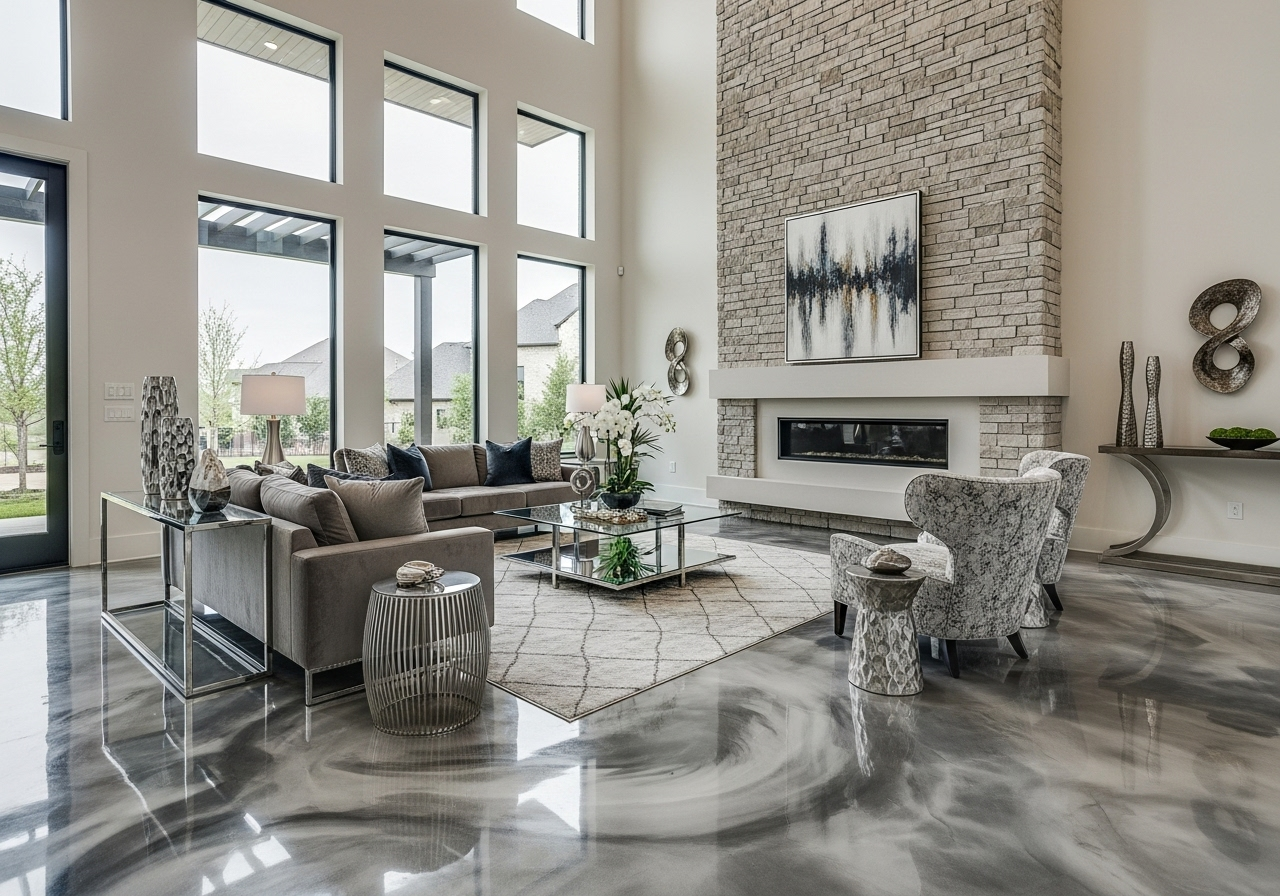
Living Room Epoxy Designs That Make an Instant Impression
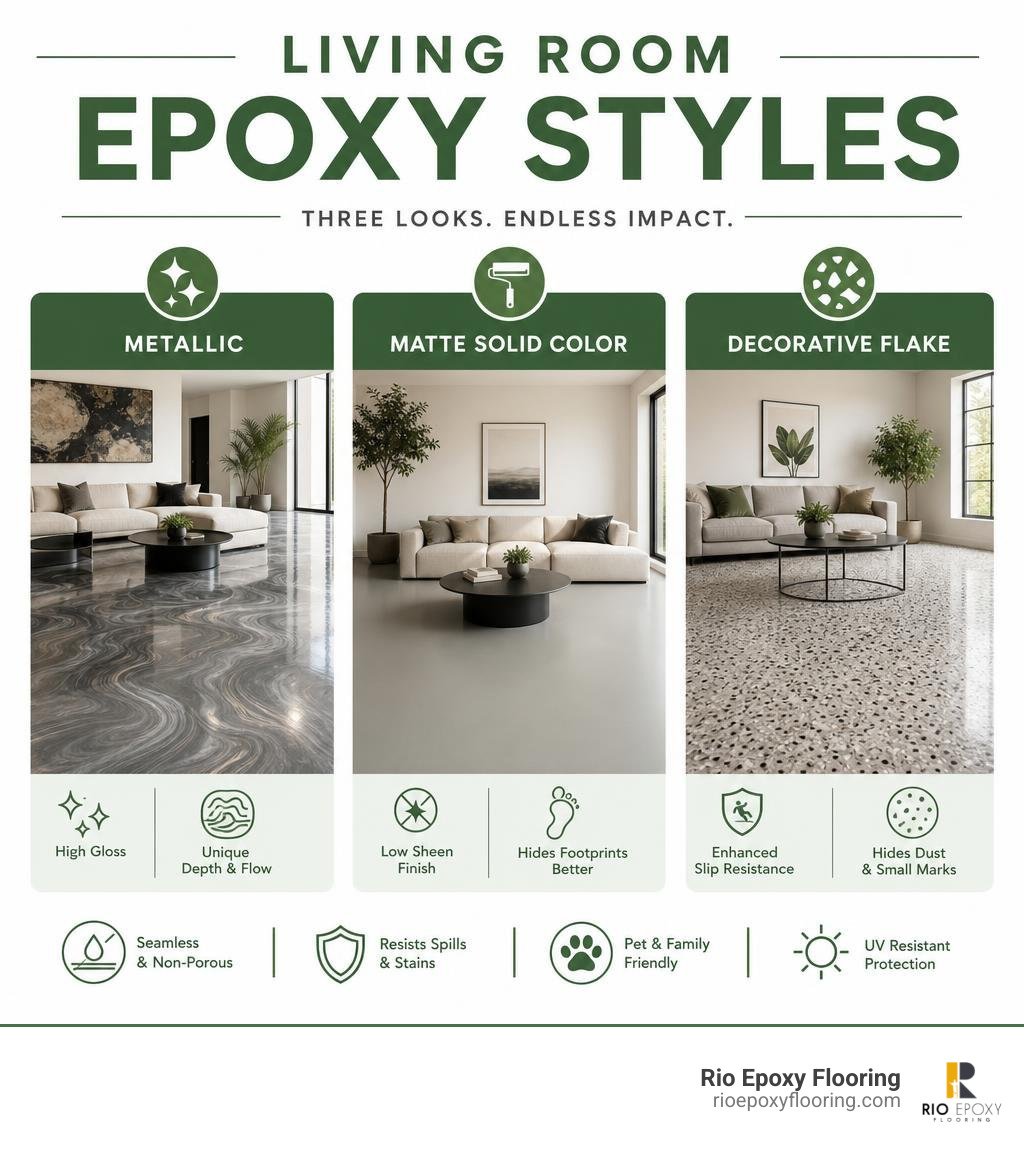
The best epoxy floor design for living room spaces depends on the mood you want to create:
- Choose metallic or marble-effect epoxy for a dramatic, one-of-a-kind floor that catches light.
- Choose solid-color epoxy with a matte or satin topcoat for a calm, modern room that hides daily footprints better than high gloss.
- Choose decorative flake epoxy for extra visual texture, stronger slip resistance, and a finish that helps disguise dust and small marks.
Unlike carpet, hardwood, and grout-lined tile, epoxy creates one seamless, non-porous surface. It resists spills, pet messes, and everyday wear while giving your living room a custom look guests will notice. For sunny Austin rooms, a UV-resistant topcoat is important to help protect the color from yellowing or fading over time.
I’m Roger Aguiar, an Austin-based business strategist and the founder of RG Agency, with years of experience helping local service businesses communicate premium home-improvement options clearly. In this guide to epoxy floor design for living room spaces, I will help you compare the styles that balance visual impact, comfort, safety, and long-term value.
Why Epoxy Outperforms Traditional Living Room Flooring
When you host friends for a weekend dinner party, the living room is where everyone gathers. Traditional flooring options often bring subtle anxieties: red wine splashing onto light-colored carpet, a high heel denting soft pine hardwood, or salsa settling deep into porous tile grout.
Epoxy resin eliminates these compromises by delivering commercial-grade resilience wrapped in an upscale, designer aesthetic. When formulated as a 100% solids system, epoxy cures through a chemical reaction between resin and hardener, turning a simple concrete foundation into a continuous, impenetrable surface. It does not peel under pressure, dent beneath heavy furniture, or harbor dust mites and pet dander.
For pet lovers, our epoxy flooring for pet owners provides a distinct advantage over hardwood. Claws that easily gouge oak or engineered planks cannot penetrate industrial-grade epoxy, and unexpected pet accidents wipe clean without soaking into the subfloor or leaving lingering odors.
When evaluating epoxy flooring vs tiles, the primary difference is the total absence of grout lines. Grout is inherently porous, acting like a magnet for dirt, spills, and moisture, while an epoxy floor offers edge-to-edge hygiene with zero seams.
| Flooring Material | Expected Lifespan | Stain & Liquid Resistance | Pet Scratch Resistance | Ongoing Maintenance Requirements |
|---|---|---|---|---|
| Custom Residential Epoxy | 15–20+ Years | Impervious (Non-Porous) | Exceptional (Industrial Topcoat) | Sweeping, damp pH-neutral mop |
| Hardwood | 10–15 Years (Between Refinishing) | Vulnerable to warping & staining | Prone to deep gouging and scratches | Sanding, staining, specialized oil soaps |
| Ceramic / Porcelain Tile | 15–20 Years | High on tile; Low on grout | High scratch resistance | Grout scrubbing, regular resealing |
| Carpet | 5–8 Years | Highly absorbent | Traps fur, pulls easily on claws | Deep steam cleaning, vacuuming |
In addition to durability, the long-term value proposition is undeniable. While hardwood requires costly refinishing every decade and carpet warrants replacement after a few years of high foot traffic, a professionally installed epoxy surface delivers decades of continuous performance.
Showstopping Epoxy Floor Design for Living Room Trends
Interior design has shifted toward bold, architectural statements. Homeowners are moving past beige builder-grade floors in favor of surfaces that act as visual centerpieces. In fact, Zillow reports a 149% year-over-year increase in searches for “color drenching”—the design practice of wrapping walls, baseboards, and floors in harmonious, cohesive color profiles.

A tailored epoxy floor design for living room spaces allows you to bounce natural sunlight across your interior, elevating ambient warmth while delivering a high-end, gallery-like aesthetic. By consulting our top 10 metallic epoxy floor ideas, you can discover how metallic powders, solid tones, and custom flakes can redefine your home’s central gathering space.
Metallic and Marble-Effect Epoxy Floor Design for Living Room Entertaining
Metallic epoxy is the pinnacle of luxury resin design. Installers mix specialized mica-based pearlescent pigments directly into the clear resin, allowing them to flow, settle, and cure into organic, three-dimensional patterns. The resulting surface mimics natural Italian marble, deep ocean currents, or polished granite—without the maintenance or brittle seams of real stone.
These flowing veins catch both natural daylight and ambient evening lighting, shifting in visual depth depending on where you stand in the room. As highlighted in our review of luxury epoxy flooring DFW trends, metallic finishes serve as an immediate focal point, creating an unforgettable backdrop for modern furniture, minimalist art, and lively dinner conversations.
Minimalist Solid and Matte Epoxy Floor Design for Living Room Warmth
For homeowners seeking understated sophistication, minimalist solid-color epoxy provides clean architectural lines. By utilizing precise RAL color systems (such as deep charcoal RAL 7015, warm taupe, or soft alabaster), you can anchor your room’s palette without overwhelming your furnishings.
While high-gloss finishes deliver a mirror-like shine, many designers opt for a satin or matte protective topcoat in main living areas. Matte surfaces scatter light evenly, reduce glare, and naturally mask footprints and stray dust between cleanings. For an added touch of subtle elegance, installers can incorporate a 1% fine glitter topcoat additive, which adds a delicate, diamond-like shimmer that only reveals itself when illuminated by direct light.
Decorative Flake and Contemporary Terrazzo Styles
Decorative flake floors—long popular in designer showrooms—have entered the luxury residential market as a stylish alternative to authentic poured terrazzo. By broadcasting multi-colored vinyl polymer chips into a pigmented base coat before sealing with a crystal-clear topcoat, installers achieve a dynamic, textured visual depth.
Discover the versatility of this method in our flake epoxy flooring breakdown. Beyond their visual appeal, flake blends naturally disguise everyday surface dust and deliver built-in traction, making them ideal for active families with children, pets, and open-door indoor-outdoor entertaining spaces.
Engineering the Perfect Living Room Floor: Substrates and Installation
A flawless living room resin finish relies heavily on the quality of substrate preparation. An epoxy installation is only as strong as the concrete foundation beneath it.
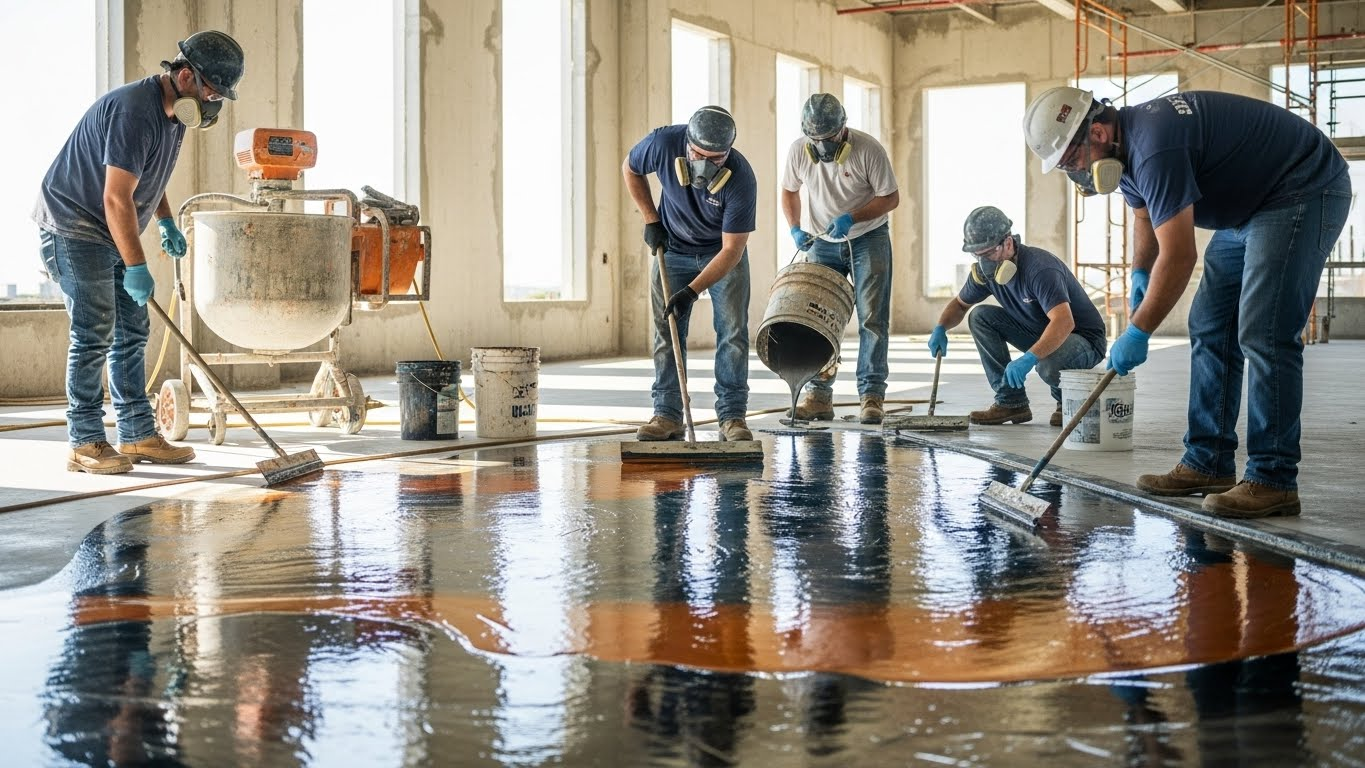
Our installation team follows a rigorous sequence to ensure lifelong chemical and mechanical adhesion:
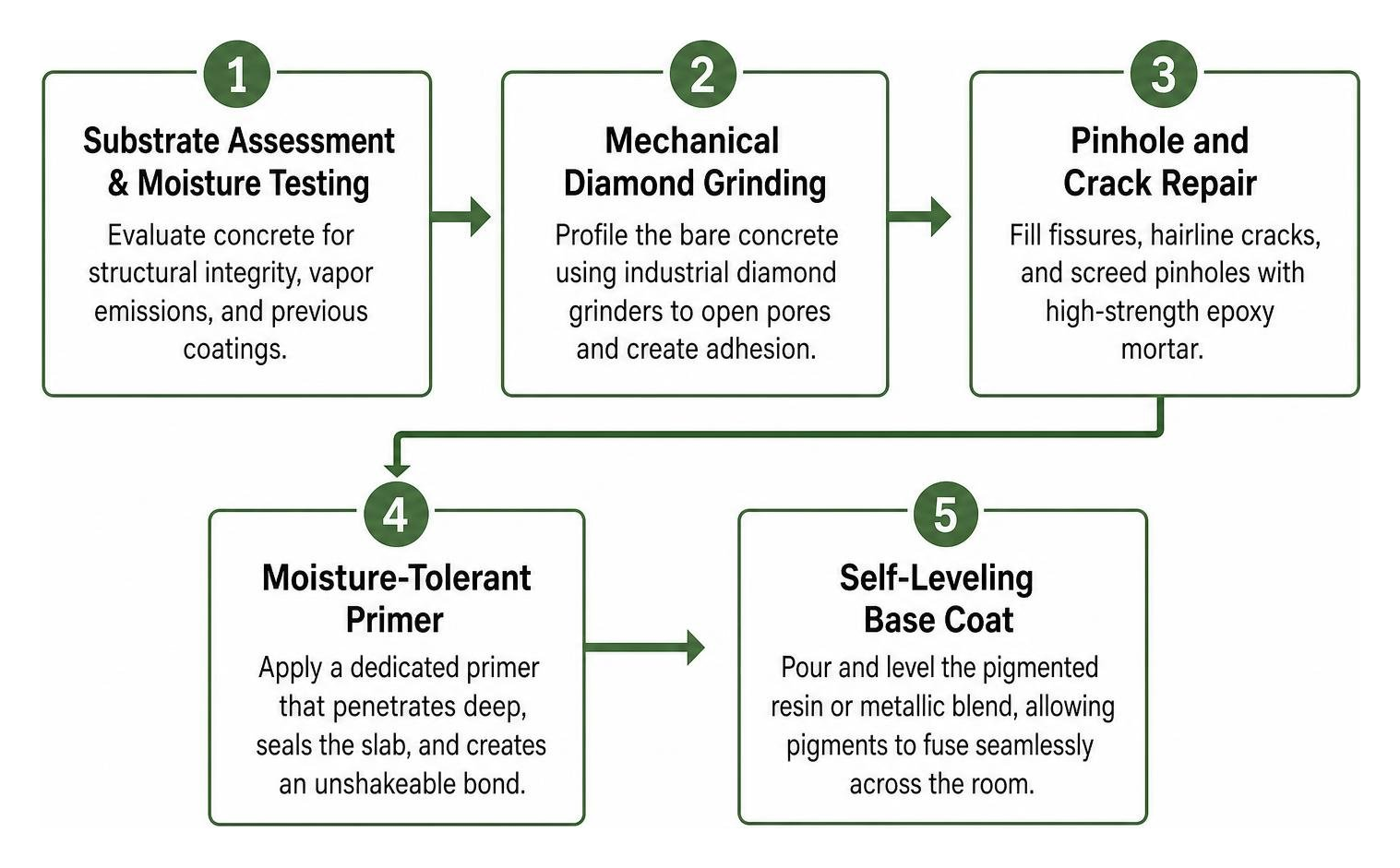
- Substrate Assessment & Moisture Testing: We evaluate the concrete for structural integrity, vapor emissions, and previous coatings. High moisture vapor levels can compromise resin adhesion, so applying an advanced moisture barrier is critical.
- Mechanical Diamond Grinding: We profile the bare concrete using industrial planetary diamond grinders. This opens up the concrete pores and creates an optimal profile for the resin to anchor into.
- Pinhole and Crack Repair: Every fissure, hairline crack, and screed pinhole is filled with high-strength epoxy mortar to prevent air bubbles from rising into the topcoat.
- Moisture-Tolerant Primer: A dedicated primer coat penetrates deep into the concrete pores, sealing the slab and creating an unshakeable bond.
- Self-Leveling Base Coat: The pigmented resin or metallic blend is poured and leveled, allowing pigments to fuse seamlessly across the room.
- Protective Topcoat: A clear polyaspartic or polyurea topcoat is applied to lock in UV stability, chemical resistance, and slip resistance.
Following the detailed steps outlined in our epoxy flooring installation guide, the surface becomes walkable in just 24 hours at standard room temperature (approx. 20°C / 68°F) and achieves full mechanical and chemical load capacity within 7 days. Additionally, epoxy is fully compatible with radiant in-floor heating systems, allowing heat to radiate efficiently through the dense, seamless resin without risk of cracking.
Health, Safety, and Long-Term Care for Interior Living Spaces
Indoor environmental safety is a top priority when choosing interior finishes. Today’s premium residential epoxy systems utilize 100% solids, ultra-low or zero-VOC formulations. As covered in our overview of low VOC epoxy flooring benefits, once fully cured, the resin becomes completely inert and non-toxic, releasing zero off-gassing fumes into your home.
Homeowners frequently ask: are epoxy floors slippery? While a mirror-smooth high-gloss floor can become slick when wet, standard residential installations achieve an R9 slip-resistance rating. Installers can easily integrate micronized aluminum oxide or transparent polymer micro-aggregates into the final clear coat to enhance foot traction without compromising design clarity.
To maintain your floor’s finish and color brilliance in sun-drenched rooms, installers finish interior spaces with UV-stable aliphatic polyurea or polyurethane topcoats. These topcoats shield underlying pigments from UV rays, preventing any ambering or yellowing over decades of sunlight exposure.
Maintaining your floor is simple. Follow our maintaining epoxy floors guide with this straightforward routine:
- Daily: Sweep or use a microfiber dry dust mop to remove loose grit.
- Weekly: Damp mop using warm water and a pH-neutral, soap-free floor cleaner.
- Protection: Place felt pads under the legs of heavy couches, coffee tables, and chairs to prevent point-load scuffing when moving furniture.
Frequently Asked Questions About Living Room Epoxy Flooring
Does epoxy flooring make a living room feel cold or echoey?
Epoxy has thermal properties similar to porcelain tile or natural slate—it feels cool to the touch during hot summer months and comfortably retains ambient room heat during winter. When paired with underfloor radiant heating, epoxy acts as an exceptional thermal conductor, distributing warmth evenly across the room.
Because epoxy is a dense, smooth surface, it can bounce sound waves in an empty room. You can easily manage room acoustics by adding plush area rugs, fabric drapery, upholstered seating, and decorative wall art, which bring cozy tactile warmth and balanced acoustics to your space.
Can epoxy be installed directly over existing tile or wood subfloors?
No. Epoxy must bond directly to a solid, porous mineral base like bare concrete or cementitious screed. Applying epoxy over flexible hardwood, engineered floating planks, or loose ceramic tiles can lead to cracking and delamination due to subfloor shifting. Existing finished floors must be removed down to the concrete slab, followed by diamond grinding and patching. If the substrate is uneven, applying a self-leveling cement underlayment will restore a flat, solid foundation before resin application begins.
How much does professional living room epoxy cost compared to other flooring?
Professional residential living room epoxy installation typically costs between $8 and $15 per square foot for bespoke metallic, marble-effect, or multi-tone designs. Factors influencing total cost include room size, substrate prep (crack filling and grinding), moisture barrier needs, and topcoat customization.
To understand why so many homeowners ask is epoxy flooring worth it, consider this cost breakdown: A standard 400-square-foot living room project at roughly $7–$10 per square foot costs between $2,800 and $4,000 upfront. Spread over an expected 15- to 20-year lifespan, the annualized cost comes out to approximately $267 per year—or just 67 cents per square foot annually. That is significantly more cost-effective than replacing stained carpet or refinishing hardwood every decade.
Conclusion
Upgrading your home with a custom resin floor combines functional durability with stunning design. Whether you love the fluid, reflective veins of custom metallic pigments, the understated beauty of a matte solid tone, or the timeless visual texture of decorative flakes, an epoxy living room floor turns everyday hosting into an elevated experience.
At Rio Epoxy Flooring, our family-owned team brings years of expert craftsmanship to Austin homeowners. We specialize in rapid 48-hour installations using low-VOC, UV-resistant materials protected by a lifetime warranty. Ready to transform your interior? Explore our curated showcase of stunning epoxy floor colors to transform your space and design a living room that will impress your dinner guests for years to come.