

How to Compare Epoxy Floor Quotes Without Missing Hidden Costs
To compare epoxy floor quotes, look beyond the total price. Ask each contractor for the same details, then compare the scope line by line:
- Price per square foot and total cost – Professional installation commonly runs from $2 to $12 per square foot, depending on the system and prep work.
- Surface preparation – Confirm whether the quote includes diamond grinding, crack repair, old-coating removal, and moisture testing.
- Coating system and warranty – Look for the resin type, number of coats, topcoat, expected thickness, cure time, and written warranty.
A low quote may leave out the work that helps a coating bond and last. For example, removing failed paint, sealers, or oil contamination can add roughly $1.50 to $3 per square foot, while major resurfacing or foundation repairs can change the budget far more. A clear, itemized estimate makes it easier to choose durable value over a price that only looks good upfront.
I’m Roger Aguiar, an Austin-based digital marketing professional with more than seven years of experience helping small and mid-sized businesses evaluate service offerings, pricing, and customer decision paths. In this guide to epoxy floor quotes, I’ll help you spot the details that make a proposal easier to trust and compare.

Understanding Average Epoxy Flooring Costs in 2026
When evaluating proposals, understanding the baseline numbers helps you identify whether a bid is competitive, suspiciously cheap, or overpriced. As of September 2026, professional epoxy flooring installation typically ranges from $2 to $12 per square foot, with the national average sitting around $6 per square foot. Most residential projects average $2,525 in total, though standard projects can range from $750 for basic partial treatments to upwards of $5,800 for multi-coat performance systems.
Labor represents a significant portion of this total—accounting for 33% to 60% of the overall cost, or roughly $1 to $7 per square foot. This labor cost reflects the skilled manual effort required to profile the concrete, mix multi-part chemical formulas precisely, and apply each layer within strict chemical open times.
You can use a 2026 epoxy flooring cost calculator to benchmark baseline prices against the dimensions of your specific space.
| Garage Size / Area | Square Footage | Basic Water-Based System ($4–$5/sq ft) | Flake / Quartz Broadcast System ($6–$9/sq ft) | Metallic / Polyaspartic System ($10–$15/sq ft) |
|---|---|---|---|---|
| 1-Car Garage | 250 sq ft | $1,000 – $1,250 | $1,500 – $2,250 | $2,500 – $3,750 |
| 2-Car Garage | 500 sq ft | $2,000 – $2,500 | $3,000 – $4,500 | $5,000 – $7,500 |
| 3-Car Garage | 750 sq ft | $3,000 – $3,750 | $4,500 – $6,750 | $7,500 – $11,250 |
| Custom Workshop | 1,000 sq ft | $4,000 – $5,000 | $6,000 – $9,000 | $10,000 – $15,000 |
Garage Dimensions and System Pricing Breakdown
The overall footprint of your concrete slab directly drives material volume and installation labor. Smaller residential footprints often carry a slightly higher price per square foot due to contractor mobilization, minimum material batches, and fixed travel costs, whereas larger spaces benefit from economies of scale. Understanding how garage size interacts with resin formulations ensures you can read itemized bids accurately:
- One-Car Garage (approx. 250 sq ft): Overall costs range between $750 and $3,000. Basic single-coat systems sit at the entry-level price point, while full multi-layer flake systems land in the mid-to-high range. Because fixed setup time remains the same regardless of square footage, minimum trip charges often raise the unit rate on smaller floors.
- Two-Car Garage (approx. 500 sq ft): The standard American garage averages $1,500 to $6,000. A high-durability broadcast flake floor typically installs for $3,000 to $4,500, offering the optimal balance between high tensile strength, UV resistance, and overall cost.
- Three-Car Garage (approx. 750 sq ft): Total investment ranges from $2,250 to $9,000, depending on concrete condition, required moisture mitigation, and resin selection. The expanded square footage allows contractors to achieve better bulk efficiencies on base resins and topcoats.
- Four-Car or Custom Workshop (1,000+ sq ft): Projects in this bracket generally run between $4,000 and $15,000. High-end workshops often demand chemical-resistant polyaspartic topcoats or metallic pigments designed to withstand heavy machinery and welding splatter.
If you are planning an upgrade in North Texas, checking regional data such as the Epoxy Garage Floor Cost Frisco TX 2026 will give you hyper-local context on standard garage layouts.
Regional Price Variations Across Major Metro Areas
Geographic location creates noticeable swings in contractor pricing due to local labor markets, climate requirements, disposal regulations, and freight costs. For example, standard quotes in San Antonio run approximately 7% below the national baseline. In contrast, Houston pricing runs about 5% higher, Dallas sits roughly 8% higher, and Austin runs around 13% above national averages due to high regional trade demand and rapid residential growth.

Local climate conditions also dictate the chemistry required in your estimate. In warm, high-humidity regions, quotes must account for vapor transmission barriers to prevent moisture trapped beneath the slab from causing delamination. If you live in Central Texas, reviewing the localized Epoxy Flooring Cost Austin Texas guide will help you understand how high summer temperatures and moisture affect local coating formulations.
Critical Cost Drivers in Epoxy Floor Quotes
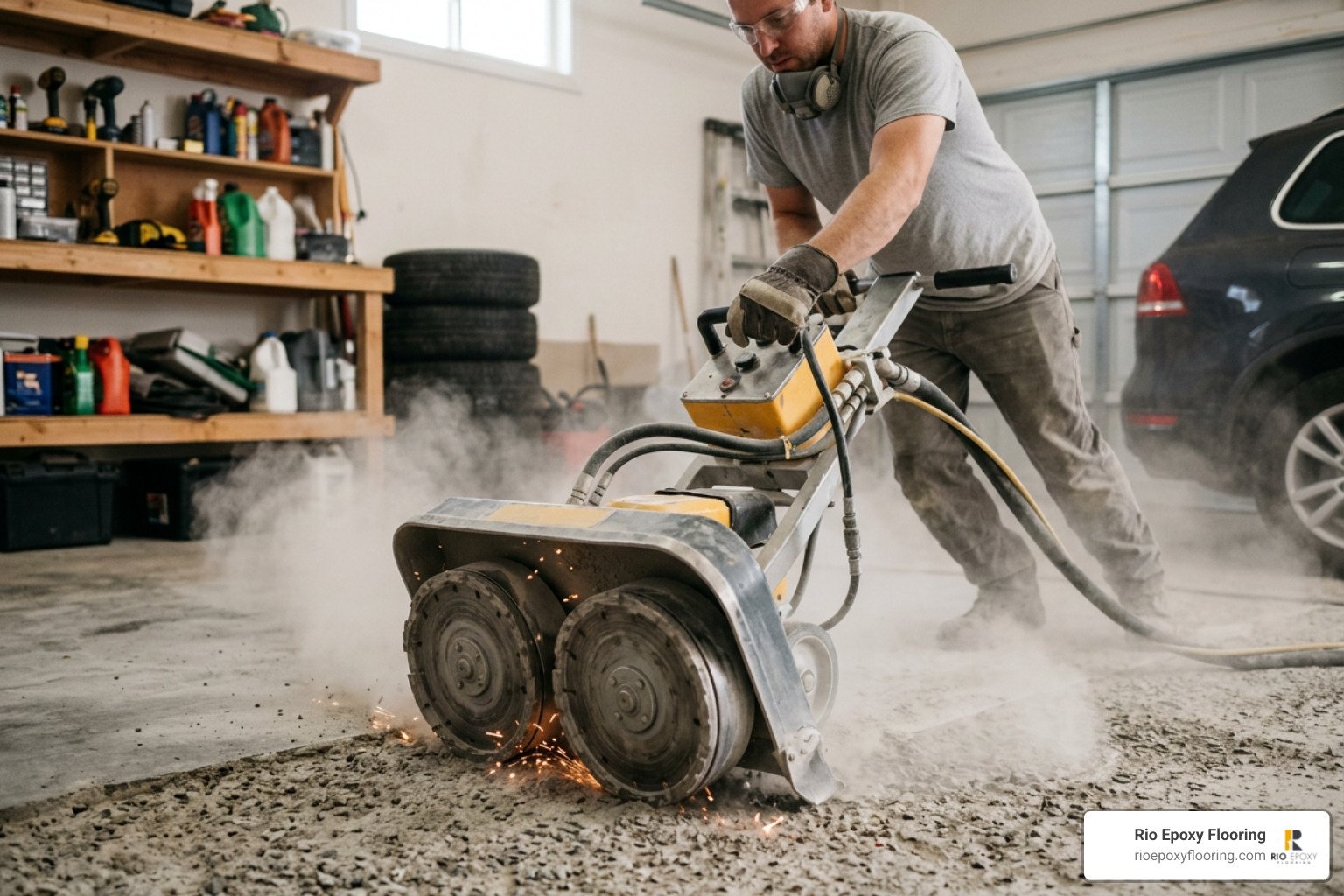
When reviewing two bids for the same garage with vastly different totals, the disparity usually comes down to three structural variables: surface preparation standards, resin chemistry, and topcoat specifications. Bids that omit these details often appear cheaper upfront but lead to early coating failure.
Surface Preparation and Concrete Repairs
A coating is only as durable as the concrete beneath it. True professional installations require mechanical surface preparation rather than simple chemical washes or acid etching. Diamond grinding or shot blasting profiles the concrete to a texture similar to 80-grit sandpaper (Concrete Surface Profile / CSP 2–3), opening the concrete pores so the primer can form an unbreakable mechanical anchor.
If your slab has existing structural imperfections, your quote should clearly separate prep and repair costs:
- Crack and Joint Patching: Minor elastomeric or epoxy crack fills range from $25 to $250 per area, preventing cracks from telegraphing through the final topcoat.
- Spall and Pitting Repair: Addressing surface scaling before coating prevents air pockets and pinholes from forming beneath the resin.
- Old Coating / Sealer Removal: Stripping failed paint, acrylic sealers, or motor oil contamination adds $1.50 to $3 per square foot.
- Moisture Vapor Mitigation: Testing moisture levels with calcium chloride or relative humidity probes determines whether an epoxy moisture barrier primer ($1.50 to $2.50/sq ft) is required to stop hydrostatic pressure from pushing the coating off the slab.
- Deep Resurfacing: Heavily damaged or deteriorated concrete requiring full resurfacing screeds costs between $1,000 and $5,000 prior to resin application. Major foundation stabilization can range from $2,150 to $7,730.
Resin Formulations: Water-Based vs. 100% Solids vs. Polyaspartics
The specific chemical formulation listed in your quote dictates how long the floor will last and how well it handles vehicle traffic, hot tires, and chemical spills.

- Water-Based Epoxy ($30 to $50 per gallon): Typically contains 40% to 60% solids, meaning up to half the liquid evaporates as it cures, leaving a thin film (around 2 to 3 mils). While economical ($4 to $5 per square foot installed), these systems last only 3 to 5 years under regular vehicle use and are highly susceptible to hot-tire pickup.
- 100% Solids Epoxy ($45 to $150 per gallon): The industry standard for heavy-duty residential and commercial applications. Because nothing evaporates during the curing reaction, it forms a thick, high-build layer (10 to 16 mils) with superior impact and chemical resistance, yielding a 10- to 20-year lifespan.
- Polyaspartic and Polyurea Coatings: High-performance aliphatic coatings offering rapid cure times (often 24 to 48 hours for a complete return to service), zero hot-tire pickup, four times the abrasion resistance of standard epoxy, and complete UV stability so the floor will never amber or yellow from direct sunlight exposure.
Decorative Add-Ons and Custom Performance Upgrades
The aesthetic finish and functional additives you select will adjust your final project estimate:
- Full Broadcast Color Flakes: Vinyl flakes broadcast to complete rejection add texture, hide concrete flaws, and provide slip resistance ($1 to $2 per square foot additional).
- Quartz Aggregate Systems: Embedded colored quartz granules create an ultra-durable, slip-resistant surface suitable for wet areas and commercial work bays ($2 to $4 per square foot additional).
- Metallic Pigments: 3D marbled metallic coatings offer designer appeal for showrooms, living areas, and luxury garages ($4 to $7 per square foot additional).
- UV-Stable Polyurethane or Polyaspartic Clear Topcoats: High-gloss or satin topcoats seal in flakes, shield against brake fluid and gasoline spills, and block yellowing from direct sunlight.
Understanding these upgrades helps you evaluate whether an estimate provides the right level of durability for your home. Reading Is Epoxy Flooring Worth It provides deeper insight into how premium coating systems protect your long-term property investment.