

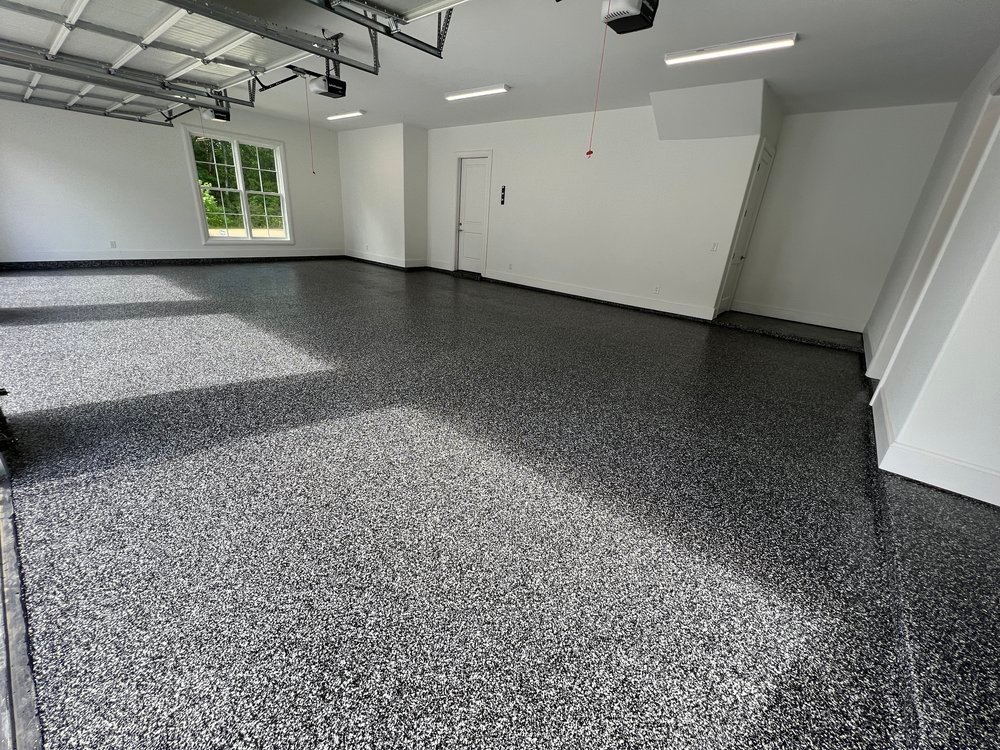
Popular Styles for Austin Garage Floor Color Chips
Selecting the right decorative flakes transforms a utilitarian space into an extension of your living environment. A vinyl flake floor is an engineered layering system consisting of a high-performance basecoat, a dense layer of decorative vinyl chips, and a resilient clear protective topcoat. This multi-layered structure delivers both aesthetic versatility and heavy-duty durability. To explore the broader benefits of this system, read our flake epoxy flooring guide.
Trending Blends of Austin Garage Floor Color Chips
Central Texas architectural trends lean toward clean lines, open concepts, and organic palettes. The most requested color chip blends among local homeowners include:
- Classic Granite and Slate Gray: Combining pure white, deep black, charcoal, and soft silver, these palettes produce a crisp, modern granite appearance. They pair exceptionally well with stainless steel cabinetry, modern tool chests, and minimalist home designs.
- Warm Earth Tones and Saddle Tan: Blends featuring mocha, cream, beige, and rich chocolate harmonize with the warm limestone facades and Hill Country aesthetics found in neighborhoods across Westlake, Lakeway, and Circle C.
- Terrazzo and Basalt Motifs: Modern multi-color chips containing subtle hints of midnight blue, copper, or sage green mimic the upscale look of poured terrazzo. These blends add custom designer flair to workshops, home gyms, and hobby spaces.
- Tuxedo and High-Contrast Monochromes: Sharp black-and-white chip mixes deliver high visual impact, offering a motorsport-inspired aesthetic for car collectors and enthusiast garages.
Sizing and Coverage Densities
Color chips are manufactured from vinyl and acrylic resins, typically sized at 1/4-inch, 1/8-inch (micro-flake), or 1/2-inch dimensions. The broadcast density—how heavily the flakes are applied across the wet basecoat—defines both the final appearance and the surface texture.
| Broadcast Density | Flake Consumption per Sq. Ft. | Basecoat Visibility | Surface Texture & Camouflage |
|---|---|---|---|
| Light Broadcast | 0.02 – 0.05 lbs | High (80% – 90% visible base) | Smooth, minimal hiding of minor surface imperfections |
| Medium Broadcast | 0.08 – 0.15 lbs | Moderate (40% – 60% visible base) | Balanced color contrast, moderate slip resistance |
| Full Broadcast | 0.50 – 0.70 lbs | Zero (100% covered substrate) | Textured, terrazzo-like appearance, maximum impact resistance |
A full-broadcast system is the industry standard for showroom finishes. Reject-to-rejection coverage forms a uniform, structural layer of flakes that completely hides the underlying concrete substrate, ensuring uniform thickness and optimal load-bearing strength.

Overcoming Central Texas Climate and Tire Wear
Austin’s climate presents significant challenges for concrete floor coatings. With intense summer heat exceeding triple digits, elevated humidity, and intense ultraviolet radiation, standard residential floor paints quickly fail. Applying a professional epoxy garage floor coating Austin TX prevents premature coating failure and handles the thermal stress unique to our region.
Moisture Vapor and Thermal Shock
Concrete is a porous, breathable material. In Central Texas, where heavy rains can quickly saturate the ground beneath garage slabs, moisture moves upward through the slab via capillary action—a phenomenon known as moisture vapor transmission (MVT). When hot garage air meets a damp concrete slab, trapped vapor creates hydrostatic pressure beneath standard paints, leading to bubbling, blistering, and delamination.
Similarly, summer driving exposes garage floors to thermal shock and hot-tire pickup. When you park a vehicle after driving on scorching Texas asphalt, the tires can reach temperatures exceeding 140°F. As the tires cool, standard epoxy can soften and chemically bond to the rubber tread, lifting the coating straight off the floor when the car pulls out. A full-broadcast vinyl chip system combined with an industrial-grade moisture-mitigating primer mechanically anchors into the concrete, eliminating hot-tire pickup entirely.
Topcoat Durability and UV Resistance
The clear topcoat is your floor’s first line of defense against abrasions, road salts, automotive fluids, and sun exposure.
- Polyaspartic Topcoats: Modern polyaspartic aliphatic polyureas offer distinct advantages over standard epoxy clear coats. They cure rapidly, provide up to four times greater abrasion resistance, and are 100% UV-stable.
- Non-Yellowing Chemistry: Garages with south- or west-facing doors receive high levels of direct sunlight along the apron and threshold. Standard epoxy resin yellows and becomes brittle under direct UV exposure. An aliphatic polyaspartic topcoat retains crystal-clear optical clarity without chalking, ambering, or cracking over decades of sun exposure.
- Chemical and Stain Protection: From synthetic motor oils and battery acids to brake fluid and dropped metal tools, polyaspartic clear coats form a non-porous chemical shield that prevents staining and makes routine cleanup simple.
Professional Installation vs. DIY in Austin

Many big-box home improvement stores sell DIY epoxy kits, tempting homeowners with the promise of an easy weekend project. However, comparing garage floor paint vs epoxy Austin reveals why DIY kits often peel within the first 12 to 24 months. Professional execution requires specialized heavy equipment and premium chemistry that retail kits cannot supply.
Installation Process and Preparation for Austin Garage Floor Color Chips
A long-lasting showroom finish relies 80% on preparation and 20% on application. Professional installers follow a disciplined multi-step process:
- Concrete Profiling via Diamond Grinding: DIY kits often recommend acid etching with muriatic acid, which frequently yields uneven results and introduces excess moisture into the slab. Professionals use heavy commercial planetary diamond grinders with industrial HEPA dust extractors. Grinding removes surface contaminants, sealers, and weak laitance while profiling the concrete to an International Concrete Repair Institute (ICRI) Concrete Surface Profile (CSP) of 2 to 3, giving it a texture similar to 60-grit sandpaper.
- Crack, Joint, and Spall Repair: Slabs are inspected for fractures, pits, and joint degradation. Technicians route out cracks and fill them with fast-setting elastomeric polyurea or structural epoxy menders, grinding them flush with the slab to create a seamless canvas.
- Moisture-Blocking Primer / Basecoat: A low-viscosity, deep-penetrating 100% solids epoxy or polyurea basecoat is mixed and applied. This base coat soaks into open concrete pores, creating a permanent mechanical bond.
- Full-Broadcast Flake Saturation: While the basecoat is still wet, technicians broadcast decorative vinyl color chips by hand until the floor is completely rejected, ensuring zero bare spots remain.
- Scraping and Reclaiming: After the basecoat cures, excess loose chips are vacuumed up. The floor is then scraped with flat spring-steel blades in multiple directions to knock down sharp edges and ensure a flat, uniform texture.
- Aliphatic Polyaspartic Clear Topcoat: The floor is completely vacuumed again, and a high-solids polyaspartic clear coat is squeegeed and back-rolled across the flakes, encapsulating the chips in an impenetrable, crystal-clear protective seal.
Project Timelines and Return-to-Service
DIY water-based epoxy kits often require 5 to 7 days before you can park a vehicle on them, and they cure very slowly in high humidity.
By contrast, professional installations utilizing rapid-curing polyurea and polyaspartic chemistries complete the entire process in as little as 24 to 48 hours. Light foot traffic is typically permitted within 6 to 8 hours following topcoat application, with full return-to-service for heavy toolboxes, gym equipment, and vehicle parking in just 24 to 48 hours.
Cost Factors, HOA Standards, and Long-Term Value
Investing in an engineered flake floor delivers a high return on investment (ROI) by protecting the structural integrity of your concrete while instantly boosting usable square footage and overall property marketability. Homeowners evaluating best garage epoxy floor services in Austin can expect clear, transparent pricing based on the specific variables of their space.
Several key factors determine the overall project cost:
- Square Footage: Standard two-car garages range between 400 and 500 square feet, while three-car spaces span 650 to 900+ square feet. Larger layouts benefit from economies of scale on raw materials.
- Substrate Condition: Extensive crack stitching, surface leveling, spall repair, or removal of old failing paint requires extra labor and materials.
- Moisture Mitigation: Slabs showing high moisture vapor emissions require an industrial-grade vapor barrier basecoat to prevent hydrostatic failure.
- Vertical Surfaces: Coating vertical concrete stem walls, steps, or custom curbings adds tailored protection and visual cohesion.
HOA Guidelines and Architectural Compliance
Most Homeowners Associations (HOAs) in master-planned communities across Travis, Williamson, and Hays counties welcome garage floor enhancements, as they elevate property standards and prevent exterior oil stains on driveways. Because color chip floors are installed inside the garage, they rarely require formal architectural review committee (ARC) approval unless the garage door is frequently left open or the coating extends past the garage threshold onto the exterior apron.
Choosing modern, neutral color chip palettes—such as granite, slate, or tan—ensures clean alignment with HOA architectural aesthetics and preserves broad resale appeal.
Routine Maintenance and Cleaning
Unlike bare concrete, which sheds dust continuously, a seamless flake system forms an impenetrable, dust-free surface. Maintaining its high-gloss showroom finish requires minimal effort:
- Weekly Upkeep: Use a soft microfiber dust mop or leaf blower to clear away dry debris, dirt, and leaves.
- Routine Washing: Mop the surface using warm water and a neutral pH cleaner (such as simple dish soap or gentle floor cleaner). Avoid harsh acidic cleaners, bleach, or high-citrus solutions, which can dull the clear topcoat over time.
- Stain Resistance: Spilled engine oil, brake fluids, transmission fluid, or antifreeze will not penetrate the non-porous polyaspartic layer. Simply wipe them up with a paper towel or rag and rinse with water.
- Deep Cleans: For stubborn mud or tire rubber marks, lightly agitate the area with a medium-stiff nylon deck brush, rinse with a garden hose, and dry with a foam squeegee.
Frequently Asked Questions About Garage Flake Systems
Can color chips be installed over existing concrete coatings?
Yes, but not directly on top of the old coating. Any existing layer of paint, failing DIY epoxy, or concrete sealer must first be completely removed via mechanical diamond grinding. Applying a high-performance system over an old coating risks total failure, because the new floor would only be as strong as the weak, unbonded layer underneath. Diamond grinding strips the surface clean down to virgin concrete, opening the pores for maximum adhesion.
Are color chip epoxy floors slippery when wet?
While full-broadcast flake floors provide natural micro-texture that offers significantly better wet traction than smooth, slick concrete paint, extra precautions are recommended. If you are curious about are epoxy floors slippery, the answer depends on texture. The vinyl flakes themselves create a gently contoured profile under the clear coat. For spaces exposed to heavy rain, poolside foot traffic, or wash bays, professional installers can incorporate micro-fine aluminum oxide or polymer anti-slip grip additives directly into the topcoat to maximize slip resistance without scratching bare feet or dulling the floor’s gloss.
How long do vinyl color chip garage floors last?
When properly installed by professionals who mechanically grind the concrete and use premium 100% solids basecoats sealed with UV-stable polyaspartic topcoats, a full-broadcast color chip floor easily lasts 15 to 20+ years. It will not peel, yellow, flake, or lift under hot tires, making it a permanent home improvement asset.
Conclusion
Upgrading your garage with decorative vinyl color chips is one of the most effective ways to boost your home’s functionality, cleanliness, and value. By combining diamond-ground surface prep, moisture-mitigating base layers, dense chip broadcasts, and UV-stable polyaspartic clear coats, you get an industrial-strength surface built to handle the Austin heat.
At Rio Epoxy Flooring, we specialize in delivering flawless, showroom-grade finishes designed specifically for Central Texas homes. Our team uses low-VOC, eco-friendly materials backed by rapid 48-hour turnarounds and lifetime warranty protection. If you are ready to upgrade your garage into a clean, durable space, explore our professional garage floor transformations to schedule your consultation today.