

Is your warehouse floor cracking, staining, or struggling to hold up under heavy forklift traffic? You are not alone. Thousands of warehouse operators across Austin, TX face the same problem every year — and most of them are losing money because of it.
Finding the right epoxy flooring warehouses Austin TX solution starts with understanding what the market offers and what your facility actually needs. This epoxy flooring warehouses Austin TX guide covers everything you need to make a smart decision: what epoxy flooring really is, which type works best for industrial environments, how the installation process works, what it costs in Austin, and the most common mistakes to avoid. Whether you manage a distribution center near the Domain, a manufacturing facility in East Austin, or a logistics hub off I-35, this guide is built for you.
Ready to protect your floor and your business? Keep reading to discover how epoxy flooring can completely transform your warehouse operations.
Get a free estimate from Rio Epoxy Flooring today. Call (737) 307-1888 or visit our commercial epoxy flooring Austin page.
What Is Epoxy Flooring and Why Do Warehouses in Austin TX Use It?
Epoxy flooring is a surface coating system made by combining epoxy resin with a polyamine hardener. When these two components react, they create an extremely hard, plastic-like material that bonds tightly to concrete. The result is a smooth, durable, chemical-resistant surface that can last 10 to 20 years in high-traffic environments.
For warehouses specifically, standard concrete simply does not hold up. Concrete absorbs oil, cracks under heavy loads, and creates dust that contaminates products. Epoxy eliminates all of those problems.
In Austin TX, warehouse owners also deal with a unique challenge: Texas heat causes concrete to expand and contract rapidly, accelerating surface degradation. A properly applied epoxy flooring system creates a protective barrier that handles these thermal cycles without peeling or delaminating.
According to industry data from the Concrete Decor Institute, epoxy-coated industrial floors can reduce maintenance costs by up to 40% over a five-year period compared to untreated concrete.
That is exactly why the demand for epoxy flooring warehouses Austin TX services has grown so consistently over the past decade.
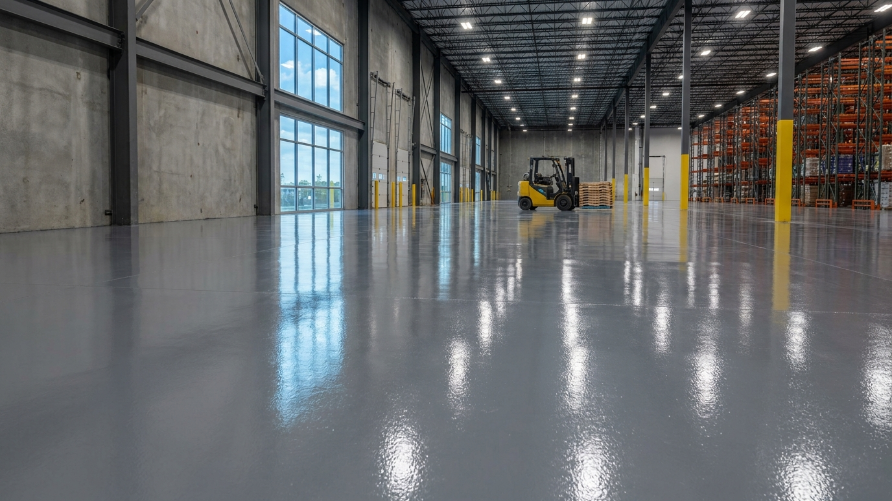
The 5 Best Types of Epoxy Flooring for Warehouses in Austin TX
When evaluating epoxy flooring warehouses Austin TX options, the coating system you choose will define how your floor performs for the next 10 to 20 years. Not all epoxy systems are created equal. Choosing the wrong one for your facility is one of the most expensive mistakes a warehouse manager can make. Below is a breakdown of the most effective options for industrial environments in Austin.
1. Self-Leveling Epoxy
Self-leveling epoxy is the most popular choice for warehouses with uneven or damaged concrete. It flows across the surface automatically, filling low spots and creating a perfectly flat, seamless finish. Thickness typically ranges from 2mm to 3mm. It handles forklift traffic, pallet jacks, and heavy foot traffic without issue.
2. Mortar Epoxy Systems
Mortar epoxy is the thickest and most durable option available — ideal for warehouses that see extreme mechanical stress. It combines epoxy resin with quartz sand or graded aggregate, creating a surface that can withstand impacts, heavy drops, and even chemical spills. If your Austin facility handles heavy manufacturing or large-scale distribution, this is the system to consider.
3. Anti-Static Epoxy (ESD Flooring)
Electronics warehouses and data storage facilities in the Austin tech corridor require floors that dissipate static electricity. Anti-static epoxy (also called ESD flooring) includes conductive additives that neutralize static buildup, protecting sensitive equipment and preventing sparks.
4. Broadcast Flake Epoxy
Broadcast flake systems add decorative vinyl chips into the epoxy during application. Beyond aesthetics, the texture adds slip resistance — an important safety factor in warehouses where spills are common. This system is also easier to clean and hides light scratches well over time.
5. Polyaspartic Epoxy Coatings
Polyaspartic is a fast-curing alternative to traditional epoxy. While technically a different compound, it is commonly categorized alongside epoxy warehouse flooring systems. It cures in as little as one hour, meaning you can return your warehouse to operation the same day. It also offers superior UV stability — critical for Austin facilities with skylights or large loading dock openings.
For a full breakdown of all available systems, explore the services page at Rio Epoxy Flooring.
Epoxy Flooring Warehouses Austin TX Guide: Step-by-Step Installation Process
Every professional epoxy flooring warehouses Austin TX project follows the same core installation sequence, regardless of the system type selected. Understanding how professional installation works helps you evaluate contractors and avoid substandard work. Here is exactly how a quality epoxy flooring warehouses Austin TX project should unfold.
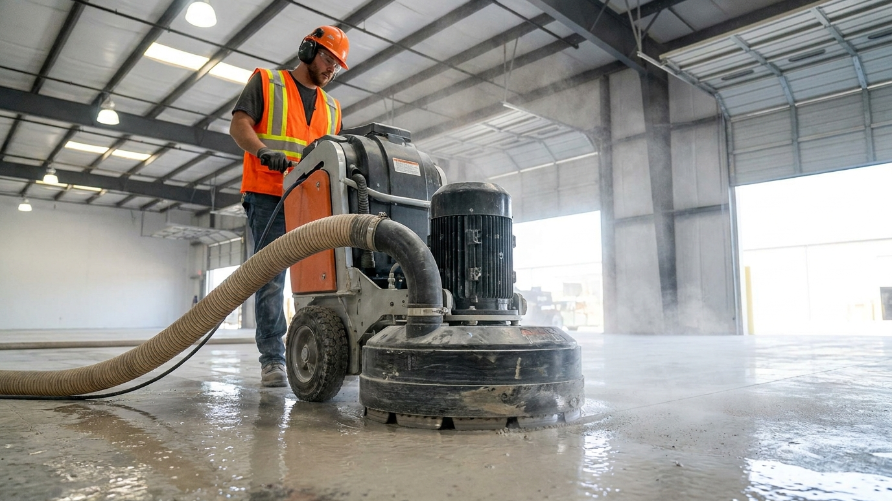
Step 1: Site Assessment and Moisture Testing
Before any product touches the floor, a qualified technician must test the concrete for moisture vapor emission. In Central Texas, ground moisture is a serious issue — moisture trapped beneath an epoxy coating causes delamination within months. Rio Epoxy Flooring uses calcium chloride and relative humidity probes to measure emission rates before every warehouse project.
Step 2: Surface Preparation (Shot Blasting or Diamond Grinding)
This is the most critical step in the entire process. The concrete must be mechanically abraded to create a surface profile — measured in CSP (Concrete Surface Profile) units — that allows the epoxy to bond properly. Shot blasting is preferred for large warehouse floors because it is faster and more consistent. Skipping or shortcutting this step is the single biggest cause of epoxy failure.
Step 3: Crack and Joint Repair
All existing cracks, spalls, and control joints are filled with polyurea or semi-rigid epoxy filler. This prevents moisture infiltration and creates a smooth substrate for the coating system.
Step 4: Primer Coat Application
A penetrating epoxy primer is applied first to seal the concrete and improve adhesion for the subsequent layers. The primer coat also acts as a moisture barrier.
Step 5: Base Coat Application
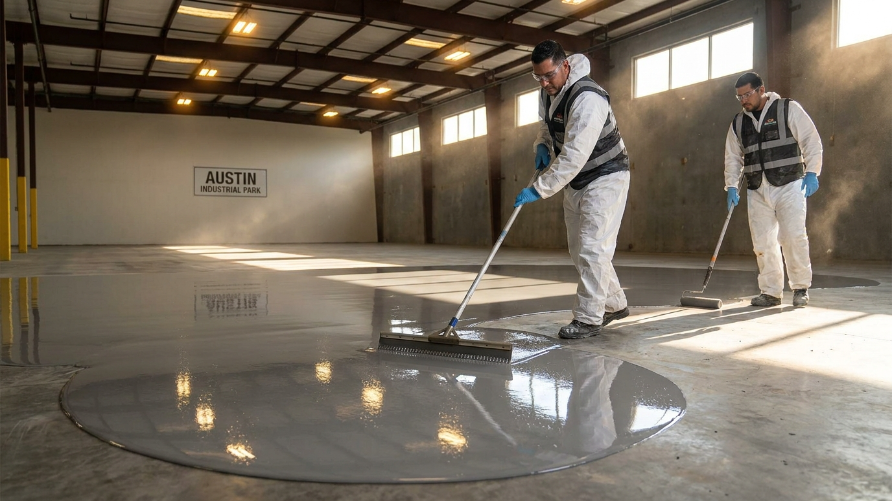
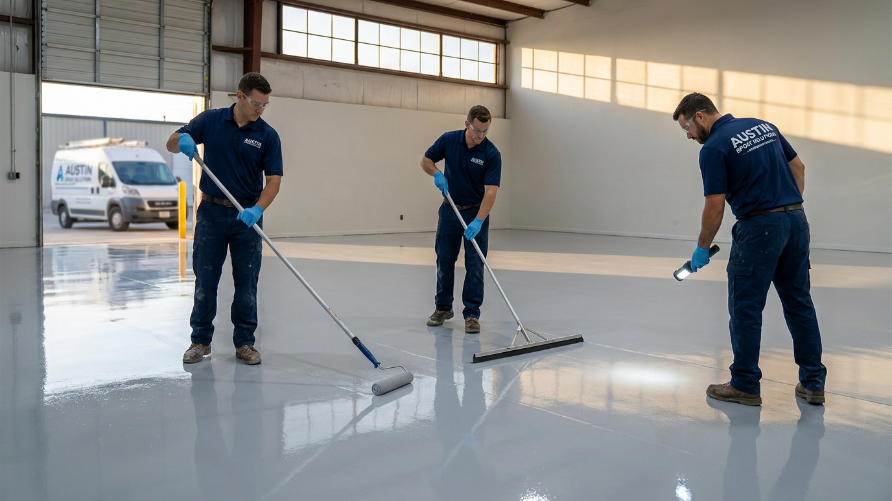
The main epoxy layer is applied using a notched squeegee and roller. Depending on the system specified, this may include broadcast aggregate (sand or flakes) applied while the coat is still wet.
Step 6: Top Coat / Sealer
The final coat is a clear polyurethane or polyaspartic sealer that protects the epoxy below from UV exposure, chemical spills, and abrasion. This is what gives the floor its gloss level — from flat matte to high mirror finish.
Step 7: Cure Time and Return to Service
Standard epoxy systems require 24–72 hours of cure time before light foot traffic. Full cure for heavy forklift traffic is typically 5–7 days. Polyaspartic systems can cut this to 4–24 hours.
How Much Does Epoxy Flooring Cost for a Warehouse in Austin TX?
Understanding epoxy flooring warehouses Austin TX pricing requires looking at both the system type and the current condition of your floor. Cost is the question every warehouse manager asks first. Here is a straightforward breakdown based on current Austin TX market rates.
| System Type | Cost per Sq Ft (Materials + Labor) | Ideal For |
|---|---|---|
| Single-coat epoxy | $2 – $4 | Light-duty storage |
| Self-leveling epoxy | $4 – $7 | General warehouses |
| Mortar epoxy | $6 – $10 | Heavy industrial |
| Broadcast flake system | $5 – $8 | Distribution centers |
| Polyaspartic coating | $5 – $9 | Fast-turnaround facilities |
For a 10,000 sq ft warehouse, you can expect to invest between $40,000 and $70,000 for a complete professional system, depending on floor condition and coating type.
Factors that affect final pricing in Austin include:
- Existing floor damage and required repairs
- Number of coats in the system
- Type of aggregate or decorative additives
- Accessibility of the facility
- Project timeline (rush projects cost more)
Rio Epoxy Flooring offers flexible financing options for larger commercial projects. Visit the financing page to learn about available payment plans.
Not sure which system fits your budget? Contact Rio Epoxy Flooring at (737) 307-1888 for a no-obligation walkthrough and quote. Our team serves warehouses across Austin and surrounding areas including Round Rock, Georgetown, Leander, and Killeen.
Why Epoxy Flooring Is Essential for Austin Warehouses: Key Benefits
The practical advantages of epoxy flooring warehouses Austin TX systems go well beyond appearance. Here are the benefits that directly impact your bottom line.
Durability Under Heavy Load
Properly installed epoxy flooring withstands concentrated loads from forklifts, pallet racks, and heavy machinery without cracking or denting. Industrial-grade epoxy systems are rated for loads exceeding 10,000 PSI — far beyond what bare concrete can reliably support over time.
Chemical and Oil Resistance
Warehouses that handle lubricants, hydraulic fluid, cleaning agents, or battery acid need a floor that does not absorb spills. Epoxy creates a non-porous barrier that prevents chemicals from penetrating and degrading the concrete underneath.
Improved Safety and OSHA Compliance
Slip-resistant epoxy systems — especially broadcast flake and quartz aggregate designs — significantly reduce slip-and-fall incidents. Properly marked floor zones (using epoxy striping) help meet OSHA aisle marking requirements, reducing your liability exposure.
Easier Cleaning and Maintenance
Smooth epoxy surfaces clean in a fraction of the time concrete requires. A standard warehouse sweep-and-mop cycle removes virtually all debris. There are no pores for bacteria or mold to colonize — an important factor for food distribution and pharmaceutical storage facilities.
Reflectivity and Energy Savings
High-gloss epoxy floors reflect up to 300% more light than raw concrete. In large Austin warehouses with high ceilings, this can meaningfully reduce the number of light fixtures required — lowering electricity costs and improving worker visibility.
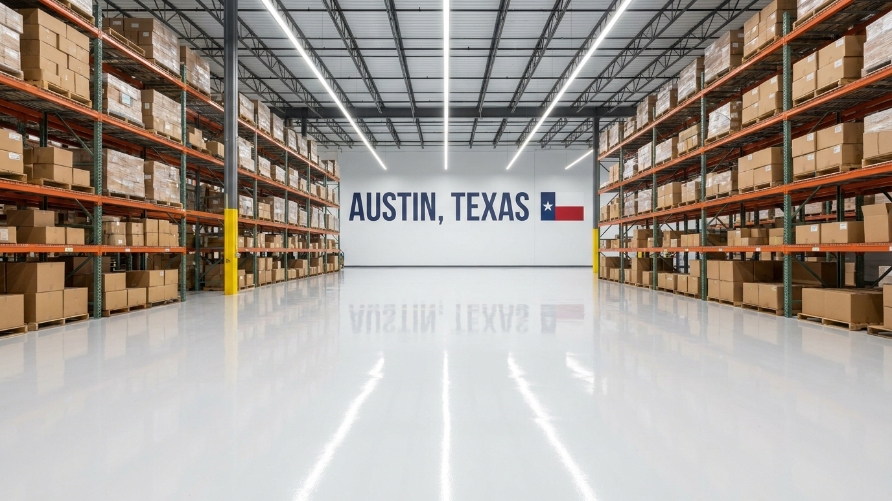
Common Mistakes to Avoid When Installing Epoxy Flooring in Warehouses
Avoiding these errors will protect your epoxy flooring warehouses Austin TX investment and ensure the coating performs as expected. The epoxy flooring warehouses Austin TX market has grown fast — and with it, the number of contractors cutting corners. These are the mistakes that lead to premature failure and costly re-dos.
Skipping Moisture Testing
This is the number one cause of epoxy delamination in Texas. Austin sits in a zone with variable ground moisture, and concrete slabs on grade are particularly susceptible. Any contractor who skips moisture testing before installation is setting up the project for failure.
Inadequate Surface Preparation
Applying epoxy to a surface that has not been properly profiled is like painting over rust — it may look fine initially, but it will peel. The concrete surface must reach a minimum CSP-3 profile for industrial epoxy systems to bond correctly.
Using the Wrong System for the Environment
A warehouse with significant chemical exposure should never receive a standard decorative epoxy system. The coating must be selected based on the actual demands of the environment — not just appearance or price.
Ignoring Expansion Joints
Concrete expands and contracts. Expansion joints must be honored in the epoxy installation — typically filled with semi-rigid filler and covered with a surface-mounted joint cap. Coating over joints without proper treatment will result in cracking above those joints within months.
Hiring Unlicensed or Inexperienced Contractors
In a market as active as Austin TX, there are many contractors who perform epoxy work without adequate training or licensing. Always ask for proof of insurance, a portfolio of completed warehouse projects, and manufacturer certifications.
Real Results: Austin Warehouse Owners on Epoxy Flooring
Real customers, real outcomes. Here is what warehouse and commercial clients in the Austin area are saying about working with Rio Epoxy Flooring.
“Rio Epoxy Flooring did an outstanding job on our commercial facility floor. The team was professional, on time, and the finish is exactly what we needed for our operations. We have had zero issues since installation.” — Google Review, 5 stars
“Incredible work on our warehouse floor. The surface preparation was thorough, and the final coating looks and performs exactly as promised. Highly recommend Rio Epoxy Flooring to any business in Austin.” — Google Review, 5 stars
You can read more client reviews on Google Maps and Yelp.
Epoxy Flooring Warehouses Austin TX: Local Considerations
Choosing epoxy flooring warehouses Austin TX contractors with local experience makes a measurable difference in long-term results. Austin is not a generic market. The specific climate, geology, and industrial landscape of Central Texas affect how epoxy flooring projects should be planned and executed.
Heat and UV Exposure
With summer temperatures regularly exceeding 100°F in Austin, polyurethane and polyaspartic top coats are strongly recommended over standard epoxy as the final seal layer. Standard epoxy yellows rapidly under UV exposure — a problem particularly relevant for loading dock areas and drive-in bays.
Limestone Substrate
Much of Central Texas sits on Edwards Plateau limestone. Warehouses built in outer Austin — in areas like Lakeway, Dripping Springs, or Barton Creek — may have slabs with unusual moisture profiles due to karst groundwater movement. This makes pre-installation moisture testing even more critical.
Austin’s Growing Industrial Corridor
The expansion of the Austin-Bergstrom industrial market, with major logistics facilities near Toll 130 and US-290, has created strong demand for professional warehouse flooring. Rio Epoxy Flooring has direct experience with facilities across this corridor and understands the specific requirements of Austin’s industrial operators.
We also serve commercial clients in Lakeway, Dripping Springs, West Lake Hills, and Barton Creek.
Maintenance Guide: How to Keep Your Warehouse Epoxy Floor in Top Condition
An epoxy floor is an investment. Protecting it with the right maintenance routine extends its lifespan and preserves its performance characteristics.
Daily Cleaning
Sweep with a microfiber dust mop or mechanical sweeper to remove abrasive particles. Grit tracked in from outdoors is the leading cause of surface scratches on warehouse epoxy floors. A clean floor is a longer-lasting floor.
Weekly Mopping
Use a neutral pH cleaner diluted in warm water. Avoid acidic cleaners (vinegar-based) and alkaline degreasers unless specifically approved for your coating system. Mop with a soft flat mop — do not use abrasive scrub pads.
Spill Response
Clean chemical spills immediately. Even chemical-resistant epoxy systems have limits. Prolonged contact with concentrated solvents or acids can eventually break down the coating. Blot — do not spread — the spill, then clean with an appropriate neutralizing agent.
Annual Inspection
Once per year, inspect the entire floor for signs of delamination (bubbling), heavy abrasion, or joint failure. Small issues caught early can be spot-repaired at low cost. Ignored damage spreads and eventually requires full system replacement.
Re-Coating Schedule
Under normal warehouse conditions, epoxy floors benefit from a maintenance top coat every 5–7 years. This refreshes the gloss, restores slip resistance, and adds another layer of protection without requiring full re-installation.
For questions about long-term maintenance or re-coating, visit the epoxy flooring FAQ page or contact Rio Epoxy Flooring directly.
Frequently Asked Questions: Epoxy Flooring for Warehouses in Austin TX
How long does epoxy flooring last in a warehouse?
With proper installation and routine maintenance, a commercial-grade epoxy flooring system in a warehouse typically lasts between 10 and 20 years. High-traffic areas near loading docks or forklift lanes may require a maintenance top coat at the 5–7 year mark to maintain full performance.
Is epoxy flooring worth it for a small warehouse in Austin?
Yes. Even for smaller facilities under 5,000 sq ft, epoxy flooring pays for itself through reduced cleaning costs, lower maintenance expenses, improved safety, and a more professional appearance. Rio Epoxy Flooring works with facilities of all sizes across Austin and surrounding areas.
What is the best epoxy coating for forklift traffic?
For forklift-heavy environments, a mortar epoxy base coat with a polyurethane or polyaspartic top coat is the most durable combination. The mortar system provides impact resistance, while the top coat protects against chemical spills and UV degradation.
How long does epoxy flooring installation take in a warehouse?
A typical 10,000–20,000 sq ft warehouse project takes 3 to 5 working days, including surface preparation and all coating layers. Polyaspartic systems can compress the schedule significantly — sometimes to 1–2 days. Always factor in the full cure period before returning heavy equipment to the floor.
Does epoxy flooring work in Austin’s climate?
Yes, but the system must be correctly specified for Texas conditions. UV-stable top coats are essential for areas with sunlight exposure. Moisture testing is critical given Central Texas soil conditions. When these factors are addressed — as Rio Epoxy Flooring does on every project — epoxy flooring warehouses Austin TX installations perform exceptionally well in any climate.
Explore More Epoxy Flooring Services in Austin
Beyond warehouse flooring, Rio Epoxy Flooring offers a full range of epoxy and surface solutions:
- Residential Epoxy Flooring — for homes, garages, and living spaces
- Garage Flooring Epoxy — durable, attractive garage floor systems
- Custom Countertops — epoxy countertop fabrication
- Pool Resurfacing — long-lasting pool surface restoration
- Areas Served — full service coverage map
Conclusion: Your Next Step Toward a Better Warehouse Floor
This epoxy flooring warehouses Austin TX guide has covered everything that matters: what epoxy is, which system is right for your facility, how installation works, realistic pricing, the most important mistakes to avoid, and how to maintain your investment for maximum lifespan.
The bottom line is straightforward. Warehouse floors take a beating. Bare concrete degrades, creates dust, absorbs chemicals, and becomes a liability. A properly installed epoxy flooring warehouses Austin TX system solves all of those problems while delivering a cleaner, safer, and more professional workspace.
Austin’s industrial market is growing. Warehouse operators who invest in quality epoxy flooring warehouses Austin TX infrastructure now protect their operations and their assets for the next decade.
Ready to upgrade your warehouse floor in Austin TX? Get your free consultation with Rio Epoxy Flooring today. Call (737) 307-1888, email contact@rioepoxyflooring.com, or visit us at 823 Congress Ave., Austin, TX 78701. Business hours: Monday–Saturday, 8am–5pm.
Contact us here — our team is ready to walk your facility and build a custom solution.
You can also explore our work and reviews on LinkedIn and YouTube.
Rio Epoxy Flooring 823 Congress Ave., Austin, TX 78701 Phone: (737) 307-1888 Email: contact@rioepoxyflooring.com Hours: Monday–Saturday, 8:00am–5:00pm