

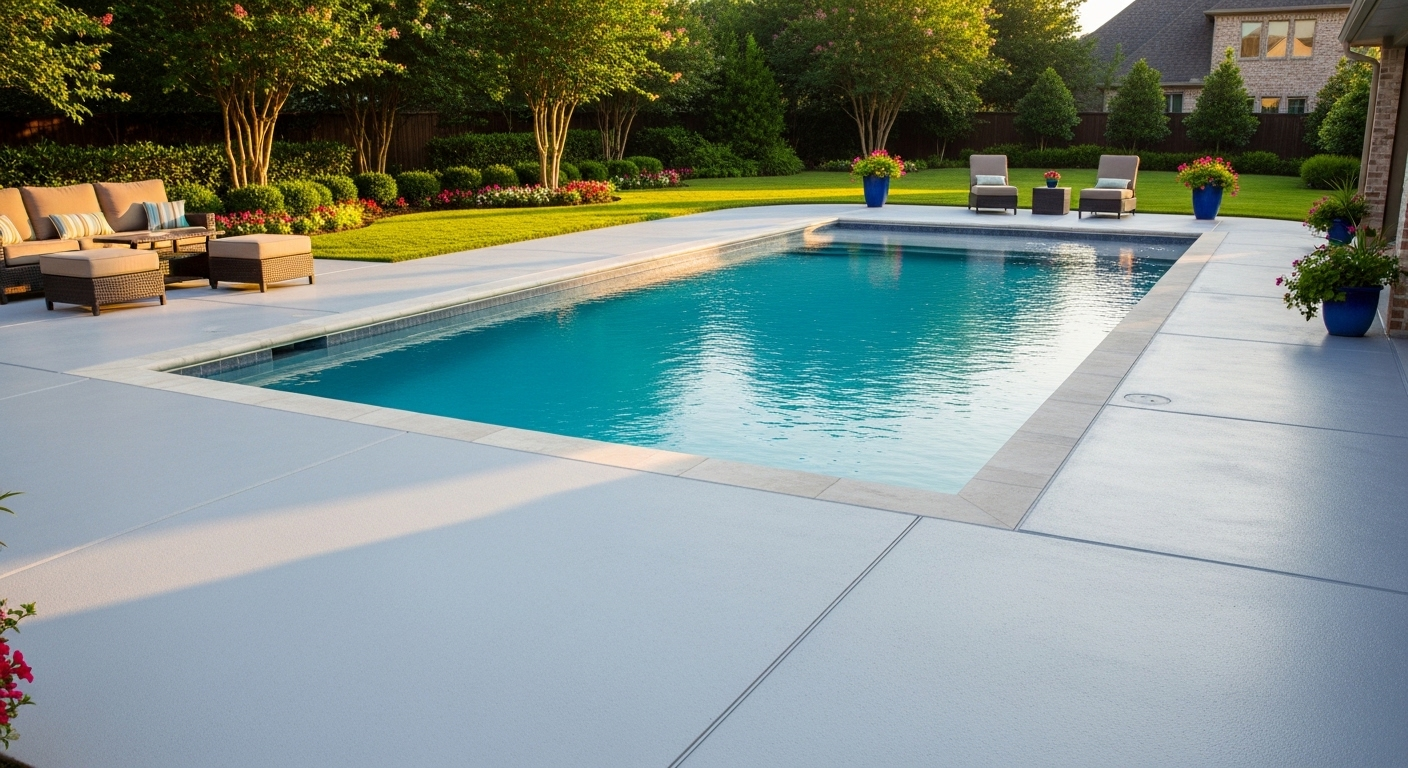
Is your pool deck peeling, fading, or cracking just as swim season approaches? Every spring, homeowners across Austin face the same question: which is better — pool deck epoxy coating vs paint? If you’ve been researching pool deck epoxy coating vs paint, you already know the options aren’t equal. The right choice affects your family’s safety, your property value, your maintenance workload, and your wallet — for years to come. This in-depth guide breaks down everything you need to know so you can make a confident, informed decision before summer arrives. The team at Rio Epoxy Flooring has coated hundreds of pool decks across Central Texas — and in this guide, we share exactly what we’ve learned. Keep reading to discover which option truly wins.
Want to skip straight to the experts? Contact Rio Epoxy Flooring today for a free quote — Austin’s trusted epoxy flooring specialists serving homeowners and businesses across Central Texas. Call (737) 307-1888, Monday–Saturday, 8am–5pm.
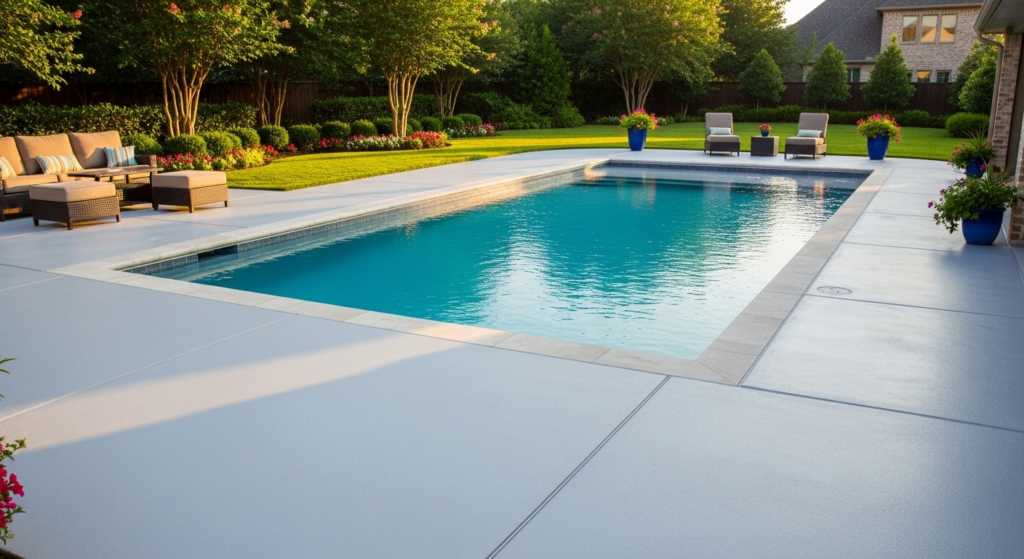
What Is Pool Deck Epoxy Coating vs Paint? Know the Difference First
Many homeowners use the terms interchangeably, but pool deck epoxy coating vs paint describes two fundamentally different products with very different outcomes. Understanding the distinction is the first step toward making the right choice for your home.
What Is Pool Deck Paint?
Pool deck paint is a surface-level coating — typically water-based acrylic or chlorinated rubber — designed to add color and a basic layer of protection to concrete. It sits on top of the surface rather than bonding chemically to it. Available at most hardware stores for $25–$45 per gallon, pool deck paint is accessible and easy to apply as a DIY project. The downside: it typically begins to peel, fade, and chip within one to three years under pool chemical exposure, UV rays, and heavy foot traffic — leaving you repainting the same surface season after season.
What Is Epoxy Coating for Pool Decks?
When we talk about pool deck epoxy coating vs paint, the epoxy side of the equation is a two-part system — a resin and a hardener — that chemically bonds with the concrete substrate when mixed and applied. This molecular-level adhesion creates a rigid, seamless, and incredibly durable surface that resists UV damage, chlorine exposure, water penetration, and abrasion far better than any paint product. A professionally installed epoxy coating can last 10 to 15 years with minimal maintenance.
At Rio Epoxy Flooring, we use commercial-grade epoxy systems specifically formulated for outdoor concrete surfaces in Texas’s demanding climate — built to handle high heat, intense UV exposure, humidity, and constant pool chemical contact.
Pool deck epoxy coating is a two-part resin-and-hardener system that chemically bonds to concrete, creating a hard, seamless, and durable surface. Unlike paint, which merely coats the surface, epoxy penetrates and adheres at a molecular level — delivering superior resistance to chemicals, UV rays, and heavy foot traffic.
Pool Deck Epoxy Coating vs Paint: Side-by-Side Comparison
| Feature | Epoxy Coating | Pool Deck Paint |
|---|---|---|
| Lifespan | 10–15 years | 1–3 years |
| Durability | Extremely high | Moderate to low |
| Chemical resistance | Excellent | Fair |
| UV resistance | High (with topcoat) | Low to moderate |
| Slip resistance | Customizable (anti-slip additive) | Basic |
| Maintenance frequency | Low | High (annual repainting) |
| Upfront cost (professional) | $3–$7/sq ft | $0.50–$1.50/sq ft |
| Long-term 10-year cost | Lower | Higher |
| Application time | 2–3 days + cure | 1 day |
| Best for | Long-term investment | Temporary fix |
When you lay out pool deck epoxy coating vs paint side by side, the winner becomes obvious for any homeowner thinking beyond the current season.
7 Powerful Reasons Epoxy Coating Beats Pool Deck Paint
Reason 1: Durability That Goes the Distance
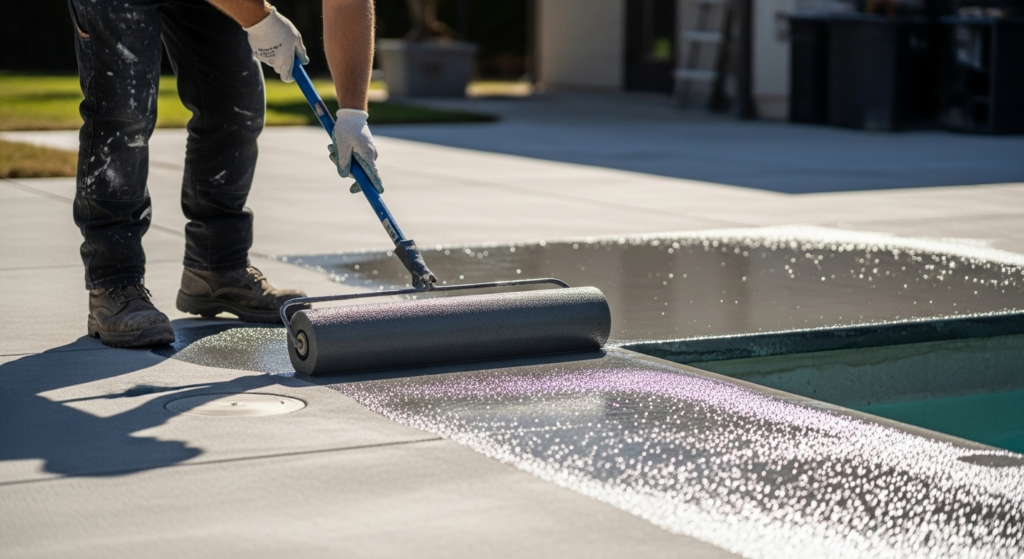
Pool decks endure a brutal daily cycle — wet feet, heavy patio furniture, pool chemicals, UV radiation, and thermal expansion from Texas’s extreme summer heat. When comparing pool deck epoxy coating vs paint under these conditions, the gap in durability is dramatic. Epoxy’s chemical bond with the concrete substrate resists cracking, chipping, and peeling even under constant heavy foot traffic and harsh weather. Paint’s surface-level adhesion begins to fail within one to three seasons under the same stress. For a surface that takes this kind of punishment, durability isn’t a luxury — it’s a requirement.
Reason 2: Chemical Resistance That Paint Simply Can’t Match
Pool water is chemically aggressive. Chlorine, pH adjusters, algaecides, and other pool maintenance chemicals constantly splash onto the surrounding deck. In the pool deck epoxy coating vs paint comparison, chemical resistance is where paint loses most dramatically. Standard pool deck paint breaks down rapidly when repeatedly exposed to chlorinated water and cleaning agents, leading to discoloration, soft spots, and widespread peeling. Epoxy coating is inherently resistant to the full range of chemicals that are a routine part of pool ownership. This is exactly why commercial pools, hotel pool decks, and aquatic centers use epoxy or polyurea systems — never standard paint.
Reason 3: Slip Resistance and Family Safety
A wet pool deck is a genuine hazard. Standard pool deck paint — even when mixed with sand additives — can become dangerously slippery when wet. Professional pool deck epoxy coating vs paint evaluations consistently point to slip safety as a decisive advantage for epoxy. Anti-slip aggregates — aluminum oxide, quartz sand, or broadcast silica — are incorporated directly into the epoxy surface layer during application, creating consistent, reliable grip even on a soaking wet surface. At Rio Epoxy Flooring, every pool deck project includes anti-slip texture options tailored for families with children and elderly guests.
Reason 4: Lower Long-Term Costs
Upfront, pool deck epoxy coating vs paint appears to favor paint on cost — but stretch that math across ten years and epoxy wins decisively. A gallon of pool deck paint runs $25–$45 and needs reapplication every one to three years. A professional epoxy installation costs $3–$7 per square foot but requires nothing but basic annual maintenance for a decade. For a 400 sq ft pool deck, that’s a one-time investment that saves thousands in repeat applications over time. That’s the real financial story behind pool deck epoxy coating vs paint when you think long-term.
Need to make the investment work within your budget? Rio Epoxy Flooring offers flexible financing options for qualified homeowners across Austin and surrounding areas.
Reason 5: Aesthetics That Outlast the Season
Pool deck paint fades. In Austin’s intense UV environment, a freshly painted deck can look chalky, uneven, and washed-out within a single season. The pool deck epoxy coating vs paint difference in aesthetics is most visible after year two — when painted decks are visibly degrading and epoxy-coated decks still look sharp. Epoxy retains its color and sheen far longer because pigment is locked within the hardened epoxy matrix rather than sitting on a porous surface. Modern decorative epoxy systems also offer flake finishes, solid colors, and metallic effects that give your pool area a high-end, resort-style appearance that no paint product can replicate.
Reason 6: Waterproofing and Concrete Protection
One of the most underappreciated advantages when evaluating pool deck epoxy coating vs paint is epoxy’s ability to seal concrete against moisture intrusion. Unsealed concrete constantly absorbs and releases water, leading to spalling, efflorescence, and long-term structural damage. A professional epoxy coating seals the surface completely — protecting the concrete itself from moisture damage and dramatically extending the life of the entire structure. For Austin homeowners dealing with seasonal rain, pool splashing, and high humidity, this moisture protection makes pool deck epoxy coating vs paint an easy call in favor of epoxy.
For comprehensive surface protection that covers both deck and pool shell, explore Rio Epoxy Flooring’s professional pool resurfacing services.
Reason 7: Minimal Maintenance, Maximum Enjoyment
Once an epoxy-coated pool deck has fully cured, maintenance is straightforward — periodic sweeping, occasional mopping with mild detergent, and a light pressure wash before each pool season. No annual repainting. No patching peeling sections. No fighting with new paint that won’t bond to contaminated old layers. In the debate over pool deck epoxy coating vs paint, the low-maintenance advantage alone is enough to sway most homeowners who value their time.
How to Properly Apply Pool Deck Epoxy Coating vs Paint: The Professional Process
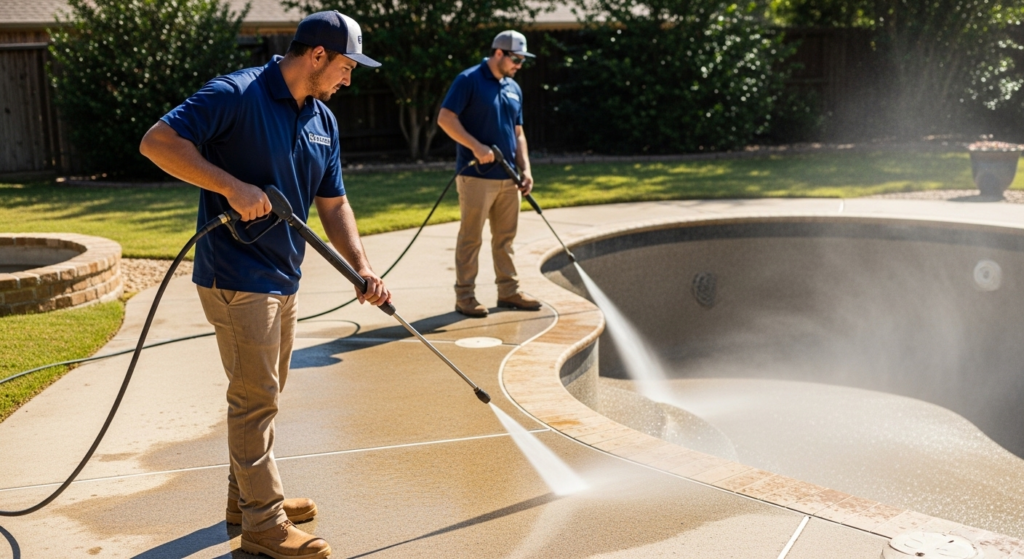
Proper surface preparation is the single most critical factor in any successful pool deck epoxy coating vs paint upgrade. Skipping steps is the number one reason DIY epoxy projects fail prematurely. Here is the professional installation process Rio Epoxy Flooring follows on every project:
- Thorough cleaning: Remove all dirt, algae, oil stains, and pool chemical residue with a commercial degreaser and high-pressure wash (minimum 3,000 PSI).
- Concrete repair: Fill all cracks, spalls, and divots with an epoxy-compatible concrete patching compound — never latex-based fillers, which fail under epoxy.
- Surface profiling: Mechanically grind or acid-etch the concrete to CSP 2–3 profile, opening the pores for chemical adhesion.
- Moisture testing: Test the concrete’s moisture vapor emission rate (MVER). Readings above 3 lbs/1,000 sq ft/24 hrs require a moisture-blocking primer before epoxy application.
- Primer application: Apply an epoxy penetrating primer to seal the surface and maximize adhesion for the base coat.
- Base coat application: Roll or spray the epoxy base coat evenly, working in sections to maintain a wet edge.
- Broadcast aggregate: Broadcast anti-slip aggregate into the wet base coat for texture, safety, and decorative effect.
- UV-stable topcoat: Apply a polyaspartic or polyurethane topcoat to protect the epoxy from UV yellowing and add a final sheen.
- Full cure time: Allow 24–72 hours before light foot traffic, and 5–7 full days before resuming pool activities.
Common Mistakes to Avoid
- Applying epoxy over existing paint: Epoxy will not bond to old, degraded paint — the existing coating must be completely removed first.
- Skipping moisture testing: Concrete with high moisture content causes bubbling and delamination within weeks of application.
- Using interior epoxy outdoors: Indoor formulas are not UV-stable and will yellow and chalk rapidly in direct sunlight.
- Choosing “epoxy paint” instead of true two-part epoxy: Choosing “epoxy paint” instead of a true two-part system — this is not a real pool deck epoxy coating vs paint upgrade; it is simply a low-performance paint with an epoxy label.
- Rushing cure time: Exposing epoxy to pool water or foot traffic before full cure compromises bond strength and surface hardness.
- Ignoring surface profile: Smooth, unprofiled concrete causes adhesion failure regardless of coating quality.
Real Results: What Austin Homeowners Are Saying
“I was going back and forth between repainting my pool deck again and finally doing epoxy. Rio Epoxy made it an easy decision. It’s been two summers and the deck still looks brand new. Zero peeling, zero fading. I wish I had done it years ago.”
— Marcus T., Austin, TX ⭐⭐⭐⭐⭐ via Google Business Profile
“The crew was professional, fast, and incredibly detailed. Our pool deck went from an embarrassment to the best-looking surface on the block. The anti-slip texture is perfect — our kids run on it all day and we never worry.”
— Sandra R., Round Rock, TX ⭐⭐⭐⭐⭐ via Yelp
“They explained the entire pool deck epoxy coating vs paint difference in detail — the prep, the primer, the UV topcoat — and you could tell they actually knew what they were doing. Results speak for themselves.”
— David L., Georgetown, TX ⭐⭐⭐⭐⭐ via Google Business Profile
Rio Epoxy Flooring proudly serves homeowners and businesses across Central Texas, including Austin, Lakeway, Round Rock, Georgetown, Leander, Dripping Springs, Killeen, Temple, West Lake Hills, Barton Creek, Rollingwood, and Sunset Valley.
Still weighing your options? Explore our full range of services or browse our FAQ page for expert answers. Ready to move forward? Call (737) 307-1888 or request a free quote online.
Is Pool Deck Epoxy Coating Worth the Investment? The 10-Year Math
When homeowners ask us whether pool deck epoxy coating vs paint is worth the higher upfront cost, we walk them through a simple 10-year comparison. The numbers make the pool deck epoxy coating vs paint decision straightforward for any homeowner with a 3+ year horizon.
10-Year Cost Comparison (400 sq ft pool deck):
| Scenario | Year 1 Cost | Years 2–10 | Total |
|---|---|---|---|
| DIY paint (annual reapplication) | $180 | $180 × 9 = $1,620 | ~$1,800 |
| Professional paint (biennial) | $800 | $800 × 4 = $3,200 | ~$4,000 |
| Professional epoxy (one-time) | $1,600–$2,800 | $0 (maintenance only) | ~$1,600–$2,800 |
A single professional epoxy installation costs less than three cycles of professional repainting — and delivers a dramatically superior surface the entire time. In Austin’s competitive real estate market, near landmarks like Barton Springs Pool and Lake Travis, a well-maintained outdoor living space also contributes measurably to perceived property value and buyer appeal. Flexible financing through Rio Epoxy Flooring makes the upfront investment even more manageable.
Pool Deck Epoxy Coating vs Paint: Frequently Asked Questions
How long does pool deck epoxy coating vs paint last?
How long does pool deck epoxy coating vs paint last? A professionally applied epoxy coating typically lasts 10–15 years; paint needs reapplication every 1–3 years due to surface-level adhesion limitations versus epoxy’s chemical bond with the concrete.
Can I apply epoxy coating over existing pool deck paint?
In the pool deck epoxy coating vs paint comparison, existing paint must be completely removed before epoxy application — never apply epoxy over old paint. Epoxy applied over existing paint will delaminate, typically within weeks, as the bond forms with the paint layer rather than the concrete itself.
Is pool deck epoxy coating slippery when wet?
Standard epoxy can be slippery when wet. However, professional epoxy pool deck installations incorporate anti-slip aggregates — aluminum oxide or broadcast silica — into the surface during application, creating consistent traction in wet pool environments.
How much does pool deck epoxy coating cost in Austin, TX?
In the Austin area, professional epoxy coating typically runs $3–$7 per square foot. Most residential projects fall between $1,200 and $4,200 depending on deck size, condition, and the system selected. Rio Epoxy Flooring offers financing options for qualified homeowners.
What is the best epoxy system for an outdoor pool deck?
A 100% solids epoxy base coat paired with a UV-stable polyaspartic or polyurethane topcoat is the industry gold standard for outdoor pool decks, providing chemical resistance, UV stability, and mechanical durability.
Beyond the Pool Deck: More Ways Rio Epoxy Flooring Can Help
If you’re investing in your outdoor spaces, consider the full picture. The same expertise that makes our pool deck projects exceptional applies across your entire property:
- Residential epoxy flooring solutions — garages, patios, basements, and more
- Garage floor epoxy — the most popular transformation for Austin homeowners
- Commercial epoxy flooring Austin — warehouses, showrooms, restaurants, and retail spaces
- Custom countertops — stunning epoxy surfaces for kitchens, bars, and outdoor entertaining areas
- Pool resurfacing — comprehensive pool shell resurfacing to complement your new pool deck
For third-party research, platforms like Angi and Houzz consistently rank epoxy flooring among the top recommended outdoor surface upgrades for homeowners.
Conclusion: The Clear Winner
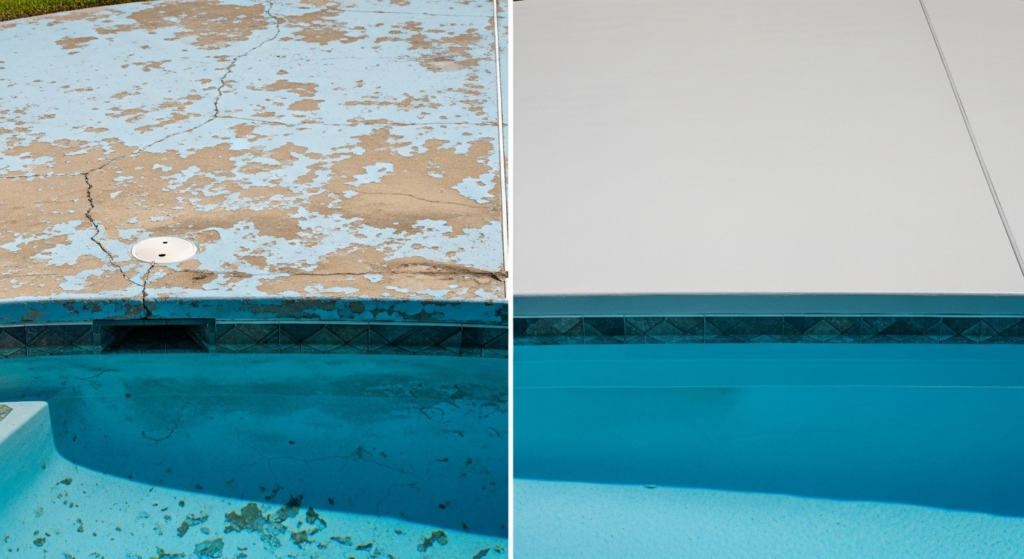
The pool deck epoxy coating vs paint debate has a clear winner for any homeowner planning to enjoy their pool for more than a couple of seasons — and that winner is epoxy, every single time. Epoxy delivers superior durability, chemical resistance, safety, moisture protection, aesthetics, and long-term cost savings — all areas where paint consistently falls short.
Spring is the ideal window to make this upgrade. A professional epoxy installation can be completed in just a few days — leaving your deck fully cured and ready before the first swim of the season. Austin homeowners who choose epoxy once almost never go back.
Ready to transform your pool deck before summer? Rio Epoxy Flooring is ready to help. Schedule your free, no-obligation consultation today — we serve Austin and all of Central Texas with professional-grade results backed by real craftsmanship.
Call: (737) 307-1888
Email: contact@rioepoxyflooring.com
Hours: Monday–Saturday, 8am–5pm
Address: 823 Congress Ave., Austin, TX 78701
Request Your Free Quote | See All Areas We Serve | Explore Financing Options