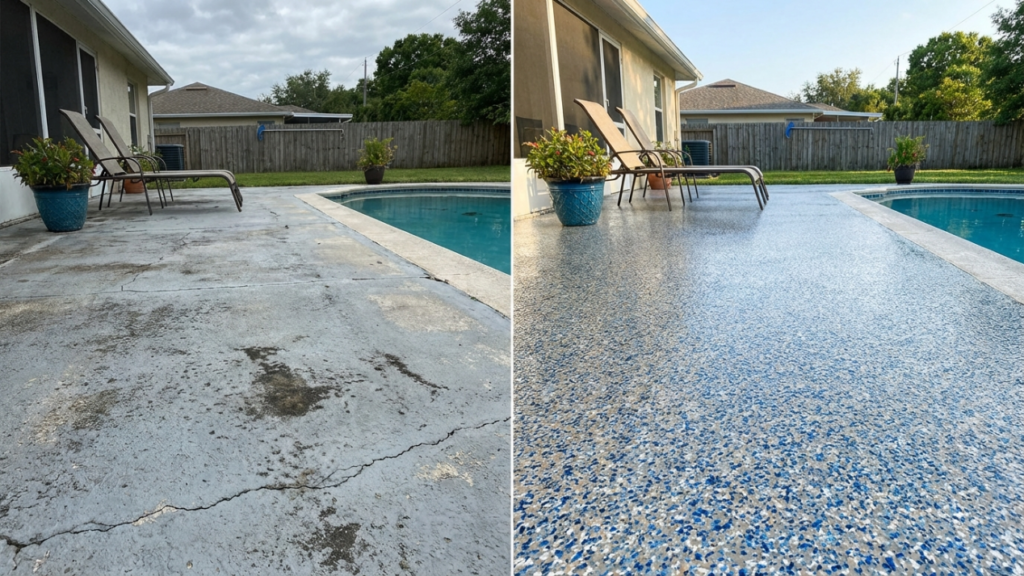

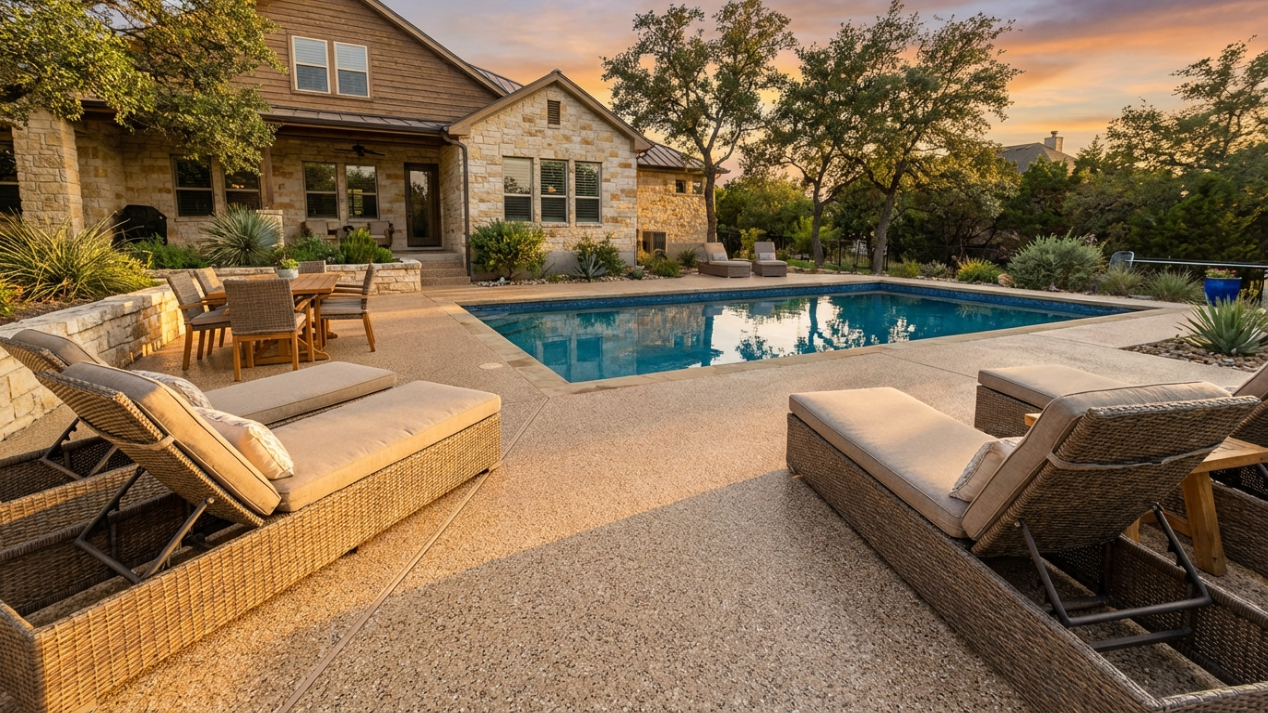
Every year, thousands of Americans are injured from slips and falls around residential pool areas — and in most cases, the culprit is a slick, deteriorating concrete deck that was never properly protected. If your pool deck is faded, cracked, or dangerously slippery when wet, a professional pool deck epoxy coating could be the single most impactful upgrade you make to your outdoor space this year.
In this complete guide, you will learn what pool deck epoxy coating is, the six most powerful benefits it delivers, the different types available in 2026, what it costs in the Austin area, how professional installation works step by step, and the critical mistakes that cause early failure. Keep reading to discover how homeowners across Austin and Central Texas are transforming unsafe, outdated pool decks into beautiful, safe, and long-lasting outdoor living spaces.
Thinking about upgrading your pool deck this season? Contact Rio Epoxy Flooring for a free estimate today.
What Is Pool Deck Epoxy Coating?
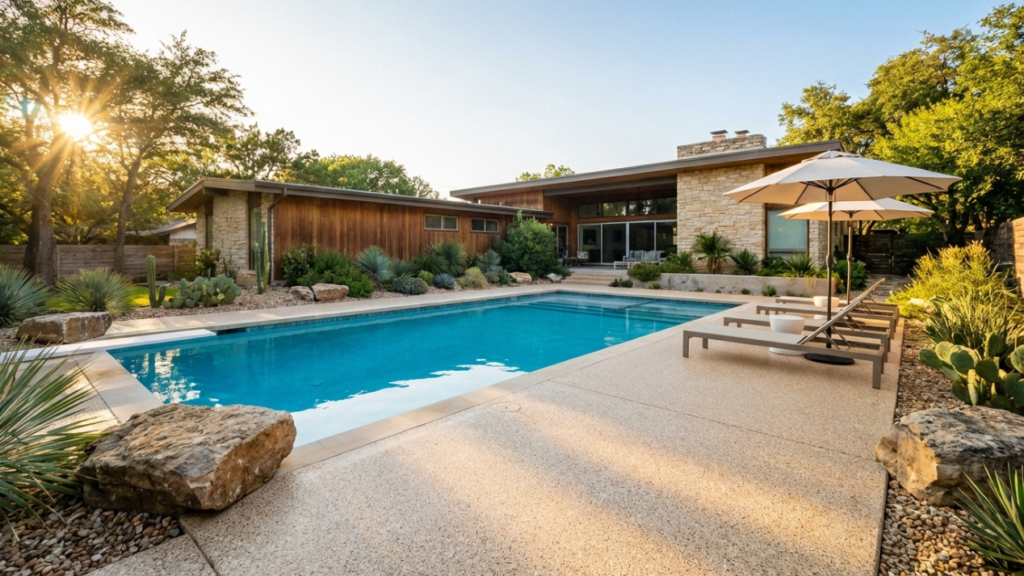
Pool deck epoxy coating is a protective, chemical-bonding surface system applied directly to concrete pool decks. It is made from two components — an epoxy resin and a hardener — that react chemically when combined and bond permanently to the concrete substrate. The result is a seamless, waterproof, and highly durable surface that resists the unique demands of a pool environment: constant moisture, chlorine and salt exposure, intense UV rays, heavy foot traffic, and temperature fluctuations.
Unlike standard deck paint, which fades, peels, and wears away within one to two seasons, a professionally installed pool deck epoxy coating is engineered to last seven to fifteen years with minimal maintenance. It can be customized with anti-slip textures, a wide range of colors, and decorative finishes that transform a plain concrete surface into a premium outdoor living space.
At Rio Epoxy Flooring, Austin’s trusted epoxy coating specialists, pool deck projects are among the most requested residential services — especially as Central Texas homeowners prepare for summer pool season each spring.
How Is Pool Deck Epoxy Coating Different from Regular Deck Paint?
Standard deck paint is a surface-level film coating. Pool deck epoxy coating penetrates the concrete pores and bonds at a molecular level, becoming part of the structure rather than just sitting on top. This fundamental difference explains why epoxy lasts many times longer, resists peeling under chlorine exposure, and maintains its appearance under Texas-level UV intensity in ways that paint simply cannot.
The 6 Powerful Benefits of Pool Deck Epoxy Coating
Pool decks face a combination of environmental stresses that few other surfaces in a home must endure simultaneously: constant moisture, chemical exposure, extreme heat, and heavy barefoot traffic. Here is why pool deck epoxy coating is the superior solution for all of them.
Benefit 1: Superior Slip Resistance and Safety
The most important benefit of a properly installed pool deck epoxy coating is safety. Anti-slip additives — including aluminum oxide, silica sand, and polymer grit — are mixed into the topcoat during application, creating a textured surface that provides secure traction even when the deck is soaking wet. This is particularly critical in Austin-area homes where pool season stretches across five to six months of the year, meaning wet surfaces are a daily reality for families with children.
Benefit 2: Waterproof and Chemical Resistant
Pool decks are constantly exposed to chlorine splash, saltwater, sunscreen, and algae-promoting moisture. Standard concrete is porous and absorbs all of it, leading to staining, discoloration, and structural deterioration over time. A pool deck epoxy coating creates a fully sealed, non-porous barrier that repels pool chemicals, prevents water intrusion, and resists staining from all common pool-related substances.
Benefit 3: UV Stability and Heat Reflection
Many epoxy coating systems are formulated with UV-stable topcoats that resist the yellowing and fading caused by direct Texas sunlight. Certain finishes also incorporate heat-reflective pigments that keep the deck surface measurably cooler underfoot — a major quality-of-life benefit on Austin summer afternoons when uncoated concrete can reach temperatures uncomfortable for bare feet.
Benefit 4: Stunning Aesthetic Versatility
Pool deck epoxy coating transforms the visual character of an outdoor space. From solid neutral tones that complement modern pool designs, to decorative flake systems that mimic natural stone, to custom color blends that match your home’s exterior palette, the design options are extensive. This level of customization is impossible with standard concrete sealers or deck paint.
Benefit 5: Low Maintenance Over the Long Term
Epoxy-coated pool decks require only basic care to maintain their appearance: a rinse with a garden hose, occasional mopping with a neutral cleaner, and prompt removal of organic debris. Because the surface is non-porous, it resists mold, algae, and staining — which are among the most time-consuming maintenance issues on untreated concrete pool decks.
Benefit 6: Cost-Effective Compared to Full Deck Replacement
A full concrete pool deck replacement can cost $15,000–$30,000 or more depending on size and scope. A professional pool deck epoxy coating achieves a like-new surface appearance for a fraction of that cost, typically $3–$11 per square foot including labor. For most homeowners, epoxy coating is the most economically rational upgrade available for an aging pool deck.
What Types of Pool Deck Epoxy Coating Are Available?
Not every pool deck epoxy coating product performs the same way in the Austin climate or under heavy residential pool use. Here is a breakdown of the main types your contractor should be familiar with.
Decorative Flake Epoxy System
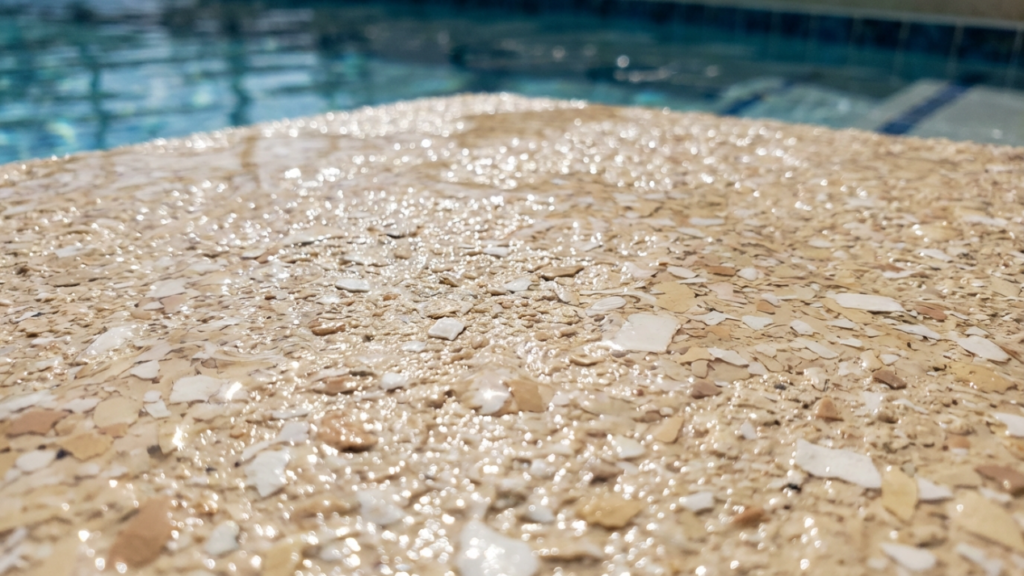
The most popular choice for residential pool decks. Colored vinyl flakes are broadcast into the wet epoxy base coat, creating a natural stone or terrazzo aesthetic that also adds meaningful texture and traction. The flake system is sealed with a UV-stable polyaspartic topcoat for maximum outdoor durability. This is the system most frequently specified by Rio Epoxy Flooring for Austin pool deck projects.
Solid Color Epoxy with Anti-Slip Aggregate
A clean, modern option that uses a single solid color in the epoxy base coat, with aluminum oxide or silica sand broadcast into the topcoat for slip resistance. Available in a wide range of colors including warm beige and sand tones that complement Texas-style outdoor living spaces.
Quartz Broadcast System
Fine quartz crystals are broadcast over the epoxy base to create a highly textured, extremely slip-resistant surface. This system is particularly well-suited for pool steps, entry ramps, and high-traffic areas where maximum grip is a priority. It delivers a refined, professional look comparable to natural stone.
Polyaspartic Topcoat System
Polyaspartic coatings are often used as the final topcoat layer over an epoxy base. They offer superior UV resistance compared to standard epoxy topcoats, faster cure times, and exceptional resistance to the specific chemicals found in pool environments — including chlorine, salt, and bromine. Many Austin-area contractors, including Rio Epoxy Flooring, use a hybrid epoxy-plus-polyaspartic system for pool deck projects to get the best of both products.
How Much Does Pool Deck Epoxy Coating Cost in 2026?
Cost is consistently the top question homeowners ask before scheduling a pool deck epoxy coating project. Here is a realistic, current breakdown for the Austin area.
Pool Deck Epoxy Coating Cost by System Type
| Coating System | Cost Per Sq Ft | Small Deck (~300 sq ft) | Large Deck (~600 sq ft) |
|---|---|---|---|
| Basic Solid Epoxy + Sealer | $3 – $6 | $900 – $1,800 | $1,800 – $3,600 |
| Decorative Flake System | $5 – $8 | $1,500 – $2,400 | $3,000 – $4,800 |
| Quartz Broadcast System | $6 – $9 | $1,800 – $2,700 | $3,600 – $5,400 |
| Epoxy + Polyaspartic Hybrid | $7 – $11 | $2,100 – $3,300 | $4,200 – $6,600 |
According to national data from Angi, the average cost for a professional epoxy pool deck project ranges from $4,000 to $8,000 for a standard residential installation. Austin-area pricing falls within this range, with variations based on deck condition, chosen system, and prep requirements.
What Affects the Final Cost?
- Deck size and shape — More square footage means higher material and labor costs. Complex shapes with curves, steps, and raised areas add to labor time.
- Surface condition — Significant cracking, existing coatings, or oil contamination require additional prep, typically adding $300–$800 to the total.
- Coating system chosen — Upgrading from basic epoxy to a hybrid polyaspartic system meaningfully increases the per-square-foot cost.
- Anti-slip additive type — Aluminum oxide costs more than standard silica sand but provides superior grip performance.
- Number of coats — A three-coat system (primer, base, topcoat) costs more than two coats but delivers significantly better durability and longevity.
If cost is a concern, Rio Epoxy Flooring offers flexible financing options designed to help Austin homeowners complete their outdoor upgrades without financial stress.
Pool Deck Epoxy Coating vs. Other Deck Surface Options
Before committing to a pool deck epoxy coating, it is worth understanding how it compares to the main alternatives.
| Surface Option | Lifespan | Slip Resistance | UV Resistance | Maintenance | Avg Cost/Sq Ft |
|---|---|---|---|---|---|
| Epoxy Coating | 7–15 yrs | Excellent (with additive) | Good–Excellent | Very Low | $3–$11 |
| Concrete Sealer | 2–5 yrs | Poor–Moderate | Moderate | Low | $1–$4 |
| Deck Paint | 1–3 yrs | Poor | Poor | High | $1–$3 |
| Stamped Concrete Overlay | 10–20 yrs | Moderate | Good | Moderate | $8–$20 |
| Natural Stone/Pavers | 20–30 yrs | Good | Excellent | Moderate–High | $15–$35 |
| Cool Deck Coating | 3–7 yrs | Good | Moderate | Low | $2–$6 |
Pool deck epoxy coating stands out as the best combination of safety, aesthetics, chemical resistance, and long-term cost efficiency for the majority of residential concrete pool decks in Austin and Central Texas.
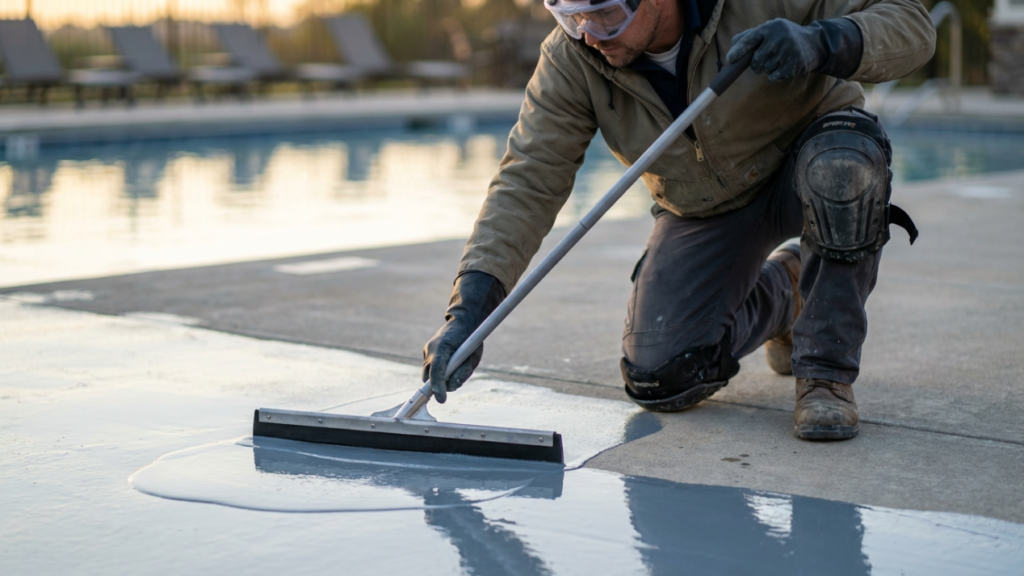
Step-by-Step: How Professional Pool Deck Epoxy Coating Is Installed
Understanding the installation process helps you evaluate contractor quotes, ask the right questions, and recognize when preparation steps are being skipped. Here is how a professional installation should proceed from start to finish.
Step 1: Surface Assessment and Damage Mapping
A trained technician inspects the entire deck for cracks, delamination, moisture intrusion, efflorescence, previous sealers, and areas of spalling. The findings determine the prep scope, product selection, and total project cost. This assessment stage is what separates a professional contractor from a cut-rate operation.
Step 2: Mechanical Surface Preparation
This is the most critical step in the entire process. For pool deck epoxy coating, surface preparation includes:
- Diamond grinding or shot blasting to open the concrete pores and create a mechanical surface profile
- Crack and joint repair using flexible, pool-compatible epoxy filler
- Degreasing to remove sunscreen, mineral deposits, and any organic residue
- Moisture testing using a plastic sheet test or moisture meter — critical because vapor transmission beneath a sealed deck causes bubbling and delamination
- Complete vacuuming and dust removal before any product is applied
Skipping or rushing any part of this step is the leading cause of coating failure on pool decks.
Step 3: Primer Coat Application
A penetrating epoxy primer is rolled onto the prepared surface in thin, even coats using a 3/8-inch nap roller in a crosshatch pattern. The primer penetrates the concrete profile and creates the bonding base for the coating system. Surface temperature must be between 50°F and 90°F during application, and at least 5°F above the dew point.
Step 4: Epoxy Base Coat and Decorative Elements
The epoxy base coat is mixed precisely according to the manufacturer’s resin-to-hardener ratio using a mechanical mixer, then applied with a squeegee and back-roller in 4×4-foot sections. For decorative flake systems, vinyl chips are broadcast into the wet coat immediately after application. The deck is then allowed to cure before excess flakes are swept and vacuumed.
Step 5: Anti-Slip Aggregate and Topcoat
Once the base coat has cured, anti-slip aggregate — aluminum oxide, silica sand, or polymer grit — is applied to the deck surface or incorporated directly into the topcoat material. The UV-stable polyaspartic or polyurethane topcoat is then applied as the final protective layer, sealing all decorative elements and providing the chemical and weather resistance that makes a pool deck epoxy coating system perform for years.
Step 6: Curing and Return to Use
Foot traffic is safe after 24 hours. Pool-adjacent use (including water splash and chemical exposure) should wait 72 hours. Full cure takes 5–7 days, during which standing water and pool chemical contact should be avoided.
The Rio Epoxy Flooring team in Austin executes every one of these steps on every pool deck project — the same professional process whether the deck is in Lakeway or West Lake Hills.
7 Common Pool Deck Epoxy Coating Mistakes to Avoid
These are the errors that result in peeling, bubbling, slippery surfaces, and premature failure — all of which are entirely preventable with proper knowledge and execution.
- Skipping surface grinding — Acid washing alone does not create adequate concrete profile for professional-grade epoxy adhesion. Mechanical grinding is non-negotiable.
- Ignoring moisture vapor — Vapor transmission from beneath the slab is the number one cause of epoxy delamination on pool decks. Always test before applying.
- Applying epoxy in direct sunlight — High surface temperatures during application cause the epoxy to cure too quickly, resulting in uneven texture and reduced penetration.
- Not adding slip-resistant aggregate — A glossy epoxy surface without anti-slip additives becomes dangerously slick when wet. Never skip this step on a pool deck.
- Using the wrong product for outdoor UV exposure — Standard interior epoxy systems yellow and degrade rapidly under direct sunlight. Pool decks require UV-stable topcoats.
- Bridging expansion joints — Coating directly over expansion joints without filling them first causes the coating to crack along those lines as the concrete moves seasonally.
- Underestimating crack repair — Surface cracks that are not properly filled before coating will telegraph through the finished surface and widen over time.
Real Austin Pool Owners Share Their Experience with Rio Epoxy Flooring
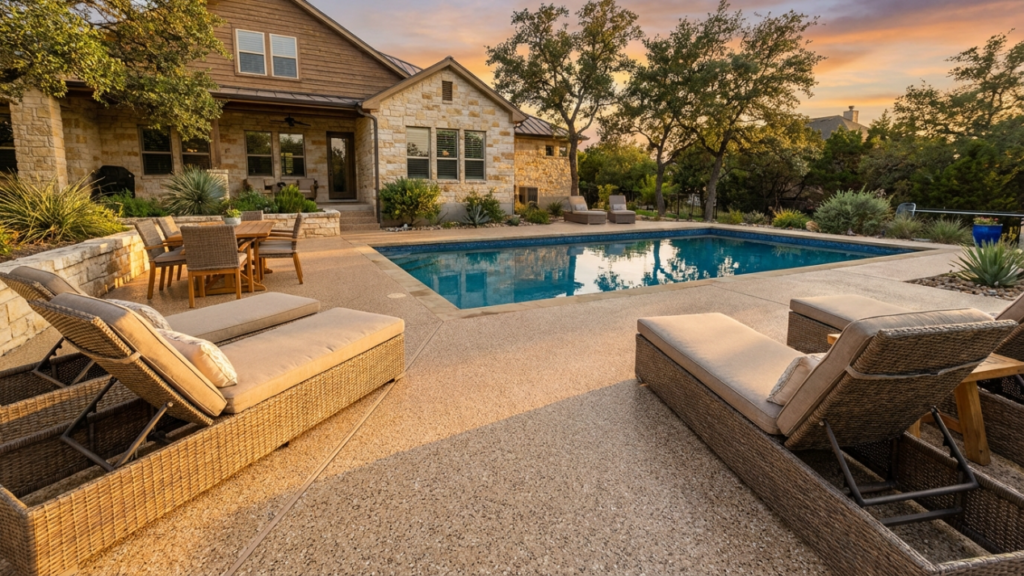
“Our pool deck was cracked and embarrassing. Rio Epoxy Flooring resurfaced it before summer and it looks incredible. The texture is perfect — our kids run on it all day and we’ve had zero slip issues.” — Amanda F., Georgetown, TX ⭐⭐⭐⭐⭐
“I was skeptical epoxy would hold up to the Austin heat and constant pool splash. A full summer later and the deck still looks brand new. Genuinely impressive work.” — Robert S., Lakeway, TX ⭐⭐⭐⭐⭐
“They matched our pool deck coating color to our home’s stone exterior. The whole outdoor area looks like a resort now. Couldn’t be happier with the result.” — Diane H., Barton Creek, TX ⭐⭐⭐⭐⭐
Read more verified reviews on Google Maps and Yelp.
Rio Epoxy Flooring serves homeowners across the entire Austin metro, including Round Rock, Georgetown, Leander, Killeen, Dripping Springs, Temple, Rollingwood, Sunset Valley, Lost Creek, Kempner, and Barton Creek. View the full service area.
Ready to transform your pool deck before summer? Get your free quote from Rio Epoxy Flooring here.
How to Maintain Your Pool Deck Epoxy Coating for Maximum Lifespan
A properly installed pool deck epoxy coating requires very little maintenance compared to bare concrete, stamped overlays, or pavers — which is one of the primary reasons pool owners make the switch. These simple practices will keep your deck looking and performing like new for years.
- Rinse the deck with a garden hose after each use to remove chlorine, sunscreen, and organic debris.
- Mop monthly with a neutral pH cleaner. Never use acid-based, bleach, or citrus cleaners that can degrade the topcoat.
- Inspect the surface seasonally for chips or micro-cracks at expansion joints and address them promptly before moisture infiltrates.
- Apply a fresh topcoat every 5–8 years in high-use areas to restore surface hardness and appearance.
- Avoid dragging heavy furniture, metal chairs, or pool equipment across the surface — use rubber-tipped feet or furniture pads.
- Do not use a pressure washer above 1,500 PSI directly on the epoxy surface, as high pressure can erode the anti-slip aggregate.
For more detailed maintenance guidance, visit the Rio Epoxy Flooring FAQ page, where the team answers the most common questions about long-term care for all epoxy coating systems.
Pool Deck Epoxy Coating and the Broader Outdoor Transformation
A pool deck epoxy coating is often the starting point for a complete outdoor living transformation. Many Austin homeowners who upgrade their pool deck also discover the possibilities of extending that same quality and cohesion to other outdoor and indoor surfaces.
If your pool itself needs attention beyond just the surrounding deck, Rio Epoxy Flooring’s professional pool resurfacing service addresses the pool interior with the same level of expertise and craftsmanship applied to the deck. For homeowners looking to carry that elevated look indoors, the team’s residential epoxy flooring solutions can extend seamless, polished surfaces from the pool deck into garages, kitchens, and living areas — creating a unified, high-end aesthetic throughout the property. Some homeowners have even paired their pool deck project with custom epoxy countertop upgrades for an outdoor kitchen or bar area adjacent to the pool.
Explore the full range of surfaces Rio Epoxy Flooring can transform on the services page, or check out the garage flooring epoxy options if you want to extend that fresh, polished look to your garage as well.
Frequently Asked Questions (FAQ)
How long does pool deck epoxy coating last?
A professionally installed pool deck epoxy coating system lasts between 7 and 15 years depending on the coating type, traffic level, and maintenance. Decorative flake and polyaspartic hybrid systems at the higher end of the quality spectrum consistently achieve the upper end of that lifespan in Austin’s climate.
Is pool deck epoxy coating slippery when wet?
Standard high-gloss epoxy without texture additives can be slippery when wet. However, a properly specified pool deck epoxy coating always includes anti-slip aggregate — aluminum oxide, silica sand, or polymer grit — mixed into the topcoat, providing secure grip even on a fully saturated surface. Always confirm your contractor includes this with the installation.
How much does pool deck epoxy coating cost in Austin?
In the Austin metro area, professional pool deck epoxy coating costs approximately $3–$11 per square foot depending on the system chosen and surface condition. A 400-square-foot deck typically costs between $1,500 and $4,400 for professional installation. Get an accurate quote for your specific project from Rio Epoxy Flooring.
How soon can I use my pool after the epoxy deck coating is applied?
Foot traffic is generally safe after 24 hours. Active pool use — including splash, chemical exposure, and pool equipment — should wait a minimum of 72 hours after application. Full chemical cure takes 5–7 days.
Can pool deck epoxy coating be applied over existing sealers or paint?
In most cases, existing coatings must be fully removed through mechanical grinding before new epoxy is applied. Epoxy bonded over old paint or sealer cannot adhere to the concrete and will delaminate prematurely. A professional surface assessment will determine the right preparation approach for your specific deck.
Does pool deck epoxy coating handle Austin’s summer heat?
Yes — when the right products are specified. UV-stable polyaspartic topcoats resist yellowing under intense Texas sun, and heat-reflective finish options keep the surface cooler underfoot than bare dark concrete. Rio Epoxy Flooring selects products specifically formulated for the temperature extremes of Central Texas summers.
Invest in a Pool Deck Epoxy Coating Before Summer Hits
A pool deck epoxy coating delivers everything a Texas homeowner needs from an outdoor surface: safety through anti-slip textures, beauty through endless design options, durability through chemical and UV resistance, and long-term value through a lifespan that outlasts standard paint by a factor of five or more. Whether your priority is protecting young children from slip injuries, restoring a cracked and faded deck to like-new condition, or simply creating an outdoor space worthy of the Austin lifestyle, epoxy coating is the clear, proven choice.
Rio Epoxy Flooring has helped hundreds of homeowners across Austin, Lakeway, Georgetown, Round Rock, and all of Central Texas upgrade their pool decks before the summer entertaining season. The team brings commercial-grade materials, certified installation expertise, and a genuine commitment to results that hold up through years of Texas summers.
Ready to start your pool deck epoxy coating project in Austin? Contact Rio Epoxy Flooring today for your free, no-obligation estimate.
Phone: (737) 307-1888
Email: contact@rioepoxyflooring.com
Address: 823 Congress Ave, Austin, TX 78701
Hours: Mon–Sat: 8am–5pm
Request Your Free Estimate | Follow on YouTube | Connect on LinkedIn