

Top Types of Decorative Concrete Coatings for Modern Spaces
Modern concrete transformations rely on distinct chemistry profiles tailored to specific functional demands. When selecting a decorative system, the decision centers on balancing chemical resistance, thermal stability, UV resistance, and aesthetic depth.
Acrylic resurfacers, standard concrete sealers, multi-layer epoxies, polyureas, and cement-urethane hybrids each solve different structural and environmental challenges. Single-component water-based acrylics excel on exterior slabs where breathability and ultraviolet stability prevent yellowing, though they offer limited resistance against hot tire pickup and aggressive solvents.
High-build industrial systems—such as 100% solids epoxy base coats paired with polyurea or aliphatic polyurethane topcoats—deliver deep film builds (10–30+ mils) designed to withstand chemical spills, impacts, and heavy traffic.
| Coating System Type | Resin Base | Typical Coverage per Gallon | Touch Dry / Recoat Window | Full Cure Time | Best Applications | Primary Strengths |
|---|---|---|---|---|---|---|
| Water-Based Acrylic | Single-Component Acrylic (35–40% solids) | 40–60 sq. ft. (textured) / up to 200 sq. ft. (sealers) | 1–2 hours / 3–4 hours | 7 days (Automotive: 72 hrs) | Patios, walkways, pool decks, residential porches | High UV stability, breathable, low VOC (<50 g/L) |
| Resinous Metallic System | 100% Solids Epoxy + Clear Topcoat | 80–120 sq. ft. (base) / 300–400 sq. ft. (topcoat) | 8–12 hours / 12–24 hours | 5–7 days | Living areas, retail showrooms, hotel lobbies | 3D visual depth, seamless, marble-like finish |
| Textured Flake / Quartz | Epoxy/Polyurea Base + Polyaspartic | 150–250 sq. ft. per layer + broadcast | 2–4 hours / 2–6 hours | 24–48 hours | Garages, commercial kitchens, pool surrounds | Impact resistance, slip prevention, UV stability |
| Cement-Urethane Hybrid | Polyurethane Resin + Portland Slurry | 30–50 sq. ft. (at 1/8″ thickness) | 4–6 hours / 6–8 hours | 24–48 hours | Food processing, commercial wash bays, breweries | Thermal shock resistance, handles hydrostatic moisture |
Metallic and Resinous Art Formulations
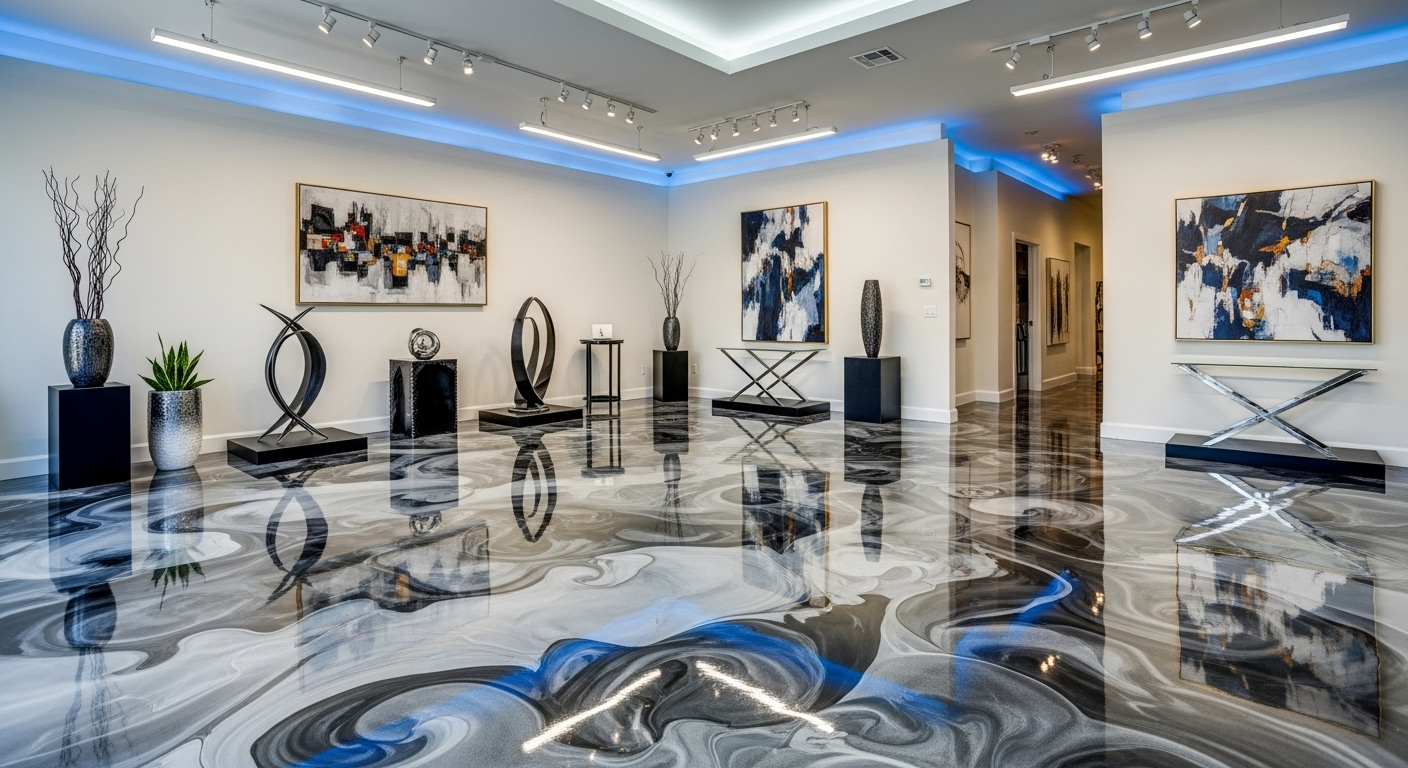
Resinous metallic floors combine clear epoxy resins with pearlescent mica pigments to create dynamic, three-dimensional surfaces. When poured and manipulated using squeegees, rollers, or alcohol dispersion sprays, the suspended metallic particles drift to produce natural marbling, swirling river effects, and visual depth.
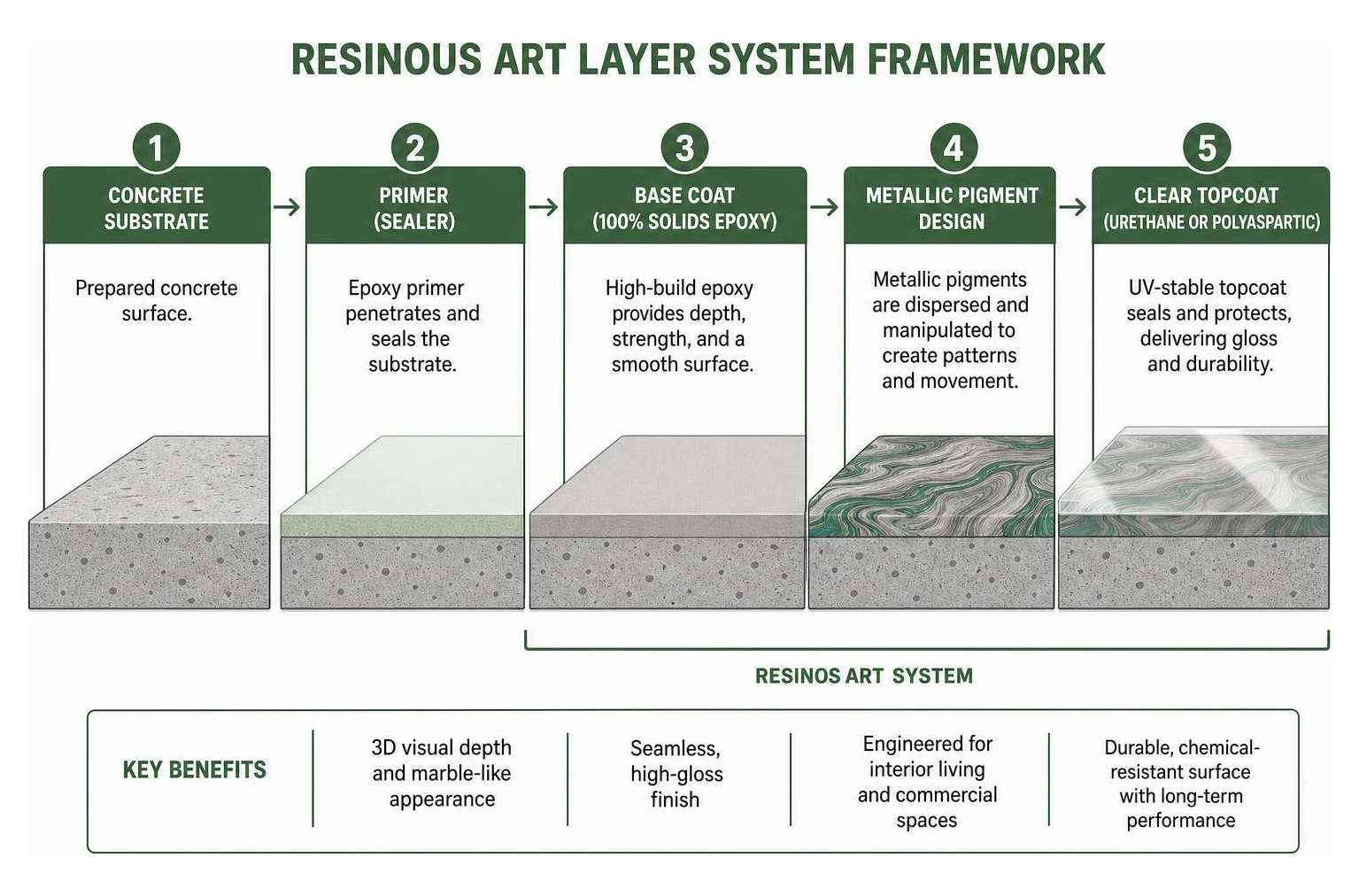
These formulations are engineered for interior living spaces, retail boutiques, and upscale commercial spaces seeking high visual impact. Choosing tailored pigments from 10 Stunning Epoxy Floor Colors Transform allows you to craft bespoke color palettes that mimic polished granite or exotic stone.
Because high-build epoxy provides a smooth, glass-like gloss, you can explore creative designs like those highlighted in our guide on Top 10 Metallic Epoxy Floor Ideas to bring custom flow patterns and depth into living areas.
Textured Flake and Quartz Systems
Broadcast flake and colored quartz systems are built for environments where slip resistance, impact durability, and heavy foot traffic converge. These multi-layer installations utilize a pigmented primer/base coat into which vinyl color chips or ceramic-coated quartz granules are broadcast to total rejection (full coverage).
Once the excess media is reclaimed and scraped flat, a high-solids clear polyaspartic or polyurethane topcoat locks in the textured aggregates.
For property owners designing safe walkways, wet rooms, or pool surrounds, our Flake Epoxy Flooring Blog covers how multi-blend color chips camouflage floor imperfections while delivering an orange-peel, non-slip profile.
Solid and Opaque Color Sealers
Solid color systems and opaque resurfacing coatings conceal severe slab discolorations, oil staining, and patchwork repairs. Formulated with high-opacity pigments and heavy-bodied acrylic or hybrid resin binders, these coatings establish a uniform baseline across mismatched concrete pours.
Unlike transparent stains that allow underlying slab blemishes to bleed through, opaque systems provide complete coverage across exterior slabs, commercial warehouses, and utility rooms. These systems can also be formulated to match integral color hardeners and architectural concrete designs while resisting UV breakdown.
Essential Surface Preparation Steps for Flawless Adhesion
No decorative resin or topical coating can outperform the slab beneath it. Applying a high-performance system over unprepared concrete leads directly to delamination, bubbling, and premature failure. Concrete is naturally porous, drawing up moisture, efflorescence, and ground minerals while accumulating surface oils and laitance.

- Hydration and Curing Verification: Fresh concrete must cure for a minimum of 28 to 30 days. Coating green concrete traps unhydrated moisture, triggering osmotic blistering and chemical breakdown of the resin.
- Moisture Vapor Transmission Testing: Slabs should be evaluated for internal relative humidity and hydrostatic pressure using calcium chloride tests (ASTM F1869) or in-situ relative humidity probes (ASTM F2170). If readings exceed safe thresholds (typically >3 lbs/1,000 sq. ft./24 hours for standard epoxy), an epoxy moisture vapor barrier primer must be applied.
- Contaminant Removal & Chemical Degreasing: Grease, engine oils, sealers, and curing compounds must be chemically lifted or mechanically removed. Unaddressed hydrocarbons prevent the coating from penetrating the concrete’s open pore structure.
- Mechanical Surface Profiling (CSP 2–3): Slabs require diamond grinding using 30–60 grit metal-bond tooling or controlled shot-blasting to open the concrete capillaries and create a profile similar to 80-grit sandpaper (Concrete Surface Profile standard 2–3). While DIY projects sometimes rely on acid etching with muriatic acid, professional installations prioritize diamond grinding to prevent residual acid salts from degrading the bond line.
- Crack and Spall Remediation: Hairline fissures and spalled joints must be routed out and filled with structural polyurea or epoxy joint repair compounds, ground flush with the substrate before priming.
- Bonding Primer Application: High-performance bonding primers penetrate the concrete matrix, consolidating weak surface laitance and creating chemical anchor points for the decorative build coats.
For complete technical specifications on mechanical profiling and slab preparation, refer to our detailed Epoxy Flooring Installation Guide Texas.
Safety Protocols and Environmental Standards for Decorative Concrete Coatings
Safety during concrete prep and application demands strict adherence to respiratory and environmental protocols. Grinding, scarifying, or sanding legacy coatings—particularly on slabs finished before 1978—can release airborne respirable crystalline silica and toxic lead dust. Installers must operate industrial dust extractors equipped with HEPA filtration stages and wear NIOSH-approved half-mask or full-face respirators (N95 or P100 rated).
Modern low-VOC standards mandate formulations containing less than 50 g/L of solvents. Using low-VOC systems keeps indoor installations compliant with regional air quality regulations while reducing unpleasant chemical off-gassing for building occupants. Always maintain cross-ventilation, wear nitrile gloves and eye protection, and keep spark sources away from solvent-borne sealers.
Step-by-Step Application and Curing Guidelines
Achieving an even, streak-free decorative finish requires close attention to ambient conditions, pot life management, and precise application techniques.
- Environmental Controls: Apply coatings only when ambient air, substrate, and material temperatures are between 50°F and 90°F (10°C to 32°C). Relative humidity must remain strictly below 85%, and the concrete temperature should stay at least 5°F above the ambient dew point to prevent condensation at the bond line. Avoid working in direct sunlight, which causes solvent pop and flash drying.
- Batch Consistency and Pot Life: Intermix (box) all containers of single-component products to prevent minor color variations. For two-part reactive epoxies, blend Part A and Part B using a low-speed mechanical drill (300–450 RPM) with an anti-entrainment mixing paddle for 2 to 3 minutes. Note the product’s pot life—once mixed, reactive polymers must be applied within 20 to 30 minutes.
- Even Material Distribution: Spread the material across the floor in 4′ x 4′ sections. Use a calibrated notched squeegee to meter the wet film thickness, followed immediately by back-rolling with a 1/4″ to 3/8″ lint-free, solvent-resistant roller cover in a cross-hatch pattern. Maintain a continuous wet edge to eliminate visible seam lines.
- Recoat Windows: Respect the product’s recoat window. Most water-based acrylics dry to the touch in 1 to 2 hours and allow recoating within 3 to 4 hours under standard conditions (70°F–77°F, 50% relative humidity). For high-performance polyaspartic and epoxy systems, apply subsequent layers within 6 to 24 hours to secure a strong chemical bond without requiring an intermediate sand-and-wipe step.
For a comprehensive overview of chemical formulations, layering methods, and system designs, explore our general Epoxy Flooring Guide.
Traffic Timelines and Long-Term Maintenance of Decorative Concrete Coatings
Managing traffic expectations during curing preserves the finish’s long-term integrity:
- Tack-Free Time (1–2 Hours): Surface resists airborne dust and debris.
- Light Foot Traffic (24 Hours): Walkways can handle pedestrian passage; keep heavy shoes and pets off the surface.
- Vehicle / Tire Traffic (72 Hours): Garages and driveways can receive passenger vehicles. High-solids industrial resins gain sufficient cross-link density by 72 hours to prevent hot tire pickup.
- Full Chemical Cure (7 Days): Resins reach maximum surface hardness (Shore D rating), mechanical tensile strength, and chemical resistance.
- Initial Washing Window (30 Days): Do not wash the surface with pressure washers, detergents, or chemical degreasers for 30 days while the resin fully stabilizes.
Maintenance and Cleanup: Clean wet tools and rollers immediately with warm soapy water for waterborne acrylics, or xylene/MEK for solvent-borne systems. Dispose of uncured resins, hardeners, and wash water in accordance with local municipal environmental ordinances—never rinse reactive chemicals into household sinks or storm drains.
For ongoing care, sweep the floor with soft dust mops and wash periodically using pH-neutral floor cleaners. Avoid harsh citrus degreasers, strong acids, or abrasive cleaning pads that can wear down the clear topcoat.
Selecting the Right System for Residential and Commercial Floors
Selecting a floor coating involves matching resin chemistries and slip profiles to the demands of each space:
- Residential Patios, Porches, and Pool Decks: Outdoor slabs demand weather-resistant, UV-stable coatings that allow moisture vapor to escape. Textured acrylic coatings, thin-mil acrylic sealers, and aliphatic broadcast polyaspartics resist intense solar exposure, driving rain, and pool chemicals without yellowing, chalking, or becoming slick underfoot.
- Garages and Home Workshops: Residential garages require materials that resist automotive fluids, battery acid, dropped hand tools, and hot rubber tires. Solid color or decorative chip broadcast systems with an epoxy primer and polyurethane/polyaspartic topcoat prevent tire staining and maintain a clean look. Learn more about our custom residential systems by viewing our Residential Epoxy Flooring Solutions.
- Retail Stores, Boutiques, and High-Traffic Showrooms: Commercial retail spaces benefit from custom visual designs that handle constant foot traffic. Metallic epoxy systems provide a seamless, high-gloss floor that brightens interior spaces through natural light reflection while simplifying daily maintenance. For high-traffic commercial projects, see our Commercial Epoxy Flooring Austin solutions.
- Commercial Kitchens, Breweries, and Light Industrial Slabs: Industrial spaces require chemical resistance, thermal shock stability against hot washdowns, and aggressive slip resistance. Seamless cement-urethane mortar overlays and quartz-broadcast industrial epoxy systems meet these rigorous operational demands. Review the commercial performance advantages in our overview of Epoxy Flooring Benefits for Commercial Spaces.
Frequently Asked Questions About Decorative Floor Systems
Can decorative coatings be applied to vertical surfaces, garages, or driveways?
Application suitability depends entirely on the resin’s viscosity and chemical design:
- Vertical Surfaces: Standard low-viscosity coatings, self-leveling epoxies, and liquid acrylics run and sag on vertical risers, concrete walls, and foundation stems. Vertical installations require thixotropic additives (such as fumed silica) or specialized vertical micro-toppings formulated to cling to upright surfaces without slumping.
- Garages: Heavy-duty garages require high-build 100% solids epoxy, polyurea, or polyaspartic systems designed to handle shear stress and hot tire pickup. Thin water-based acrylic paints often fail in garage environments because hot tires soften the resin, pulling it right off the slab.
- Driveways: Driveway coatings must be breathable and UV stable. Clear penetrating silane-siloxane sealers or UV-stable acrylic sealers handle vehicular loads while releasing subterranean moisture. Non-breathable, moisture-sensitive epoxies should not be used on exterior driveways exposed to ground moisture and direct sunlight.
How long should new concrete cure before applying a decorative coating?
Freshly placed concrete must cure for a minimum of 28 to 30 days before applying non-breathable resinous coatings. During this 4-week window, Portland cement undergoes internal hydration, consuming water and developing its structural compressive strength.
Coating a slab prematurely traps excess water, building moisture vapor pressure that triggers blistering, micro-cracking, and adhesive failure. Always perform a plastic sheet test (ASTM D4263) or use a calibrated electronic concrete moisture meter before installation.
What is the expected warranty and lifespan for professional coatings?
Entry-level single-component acrylic DIY coatings typically carry a 1-year limited product warranty and require re-coating every 2 to 4 years under regular foot traffic and weather exposure. In contrast, professional-grade multi-layer systems—combining diamond-ground mechanical preparation, 100% solids base coats, full flake/quartz broadcasts, and UV-stable polyaspartic topcoats—frequently deliver a lifespan of 15 to 25+ years without peeling or yellowing.
Professional installations protect your investment with robust, long-term warranties covering peeling, delamination, and material defects.
Conclusion
Upgrading plain concrete slabs into clean, resilient surfaces brings lasting durability, easier maintenance, and elevated visual appeal to any residential or commercial property.
Whether you are refinishing an outdoor patio with a textured, slip-resistant acrylic system, protecting a busy garage floor with a multi-layer broadcast flake system, or creating high-end interior spaces with metallic resin art, long-term success comes down to careful surface preparation, matching the chemistry to the environment, and respecting product cure times.
At Rio Epoxy Flooring, we specialize in transforming standard concrete into durable, architectural floor finishes across residential and commercial spaces. Our team installs custom epoxy, polyurea, and cement-urethane floor systems featuring rapid 48-hour turnarounds, ultra-low-VOC and UV-stable formulations, and lifetime warranty protection.
Contact us today to explore our custom concrete transformation services and let us help bring your flooring vision to life.