

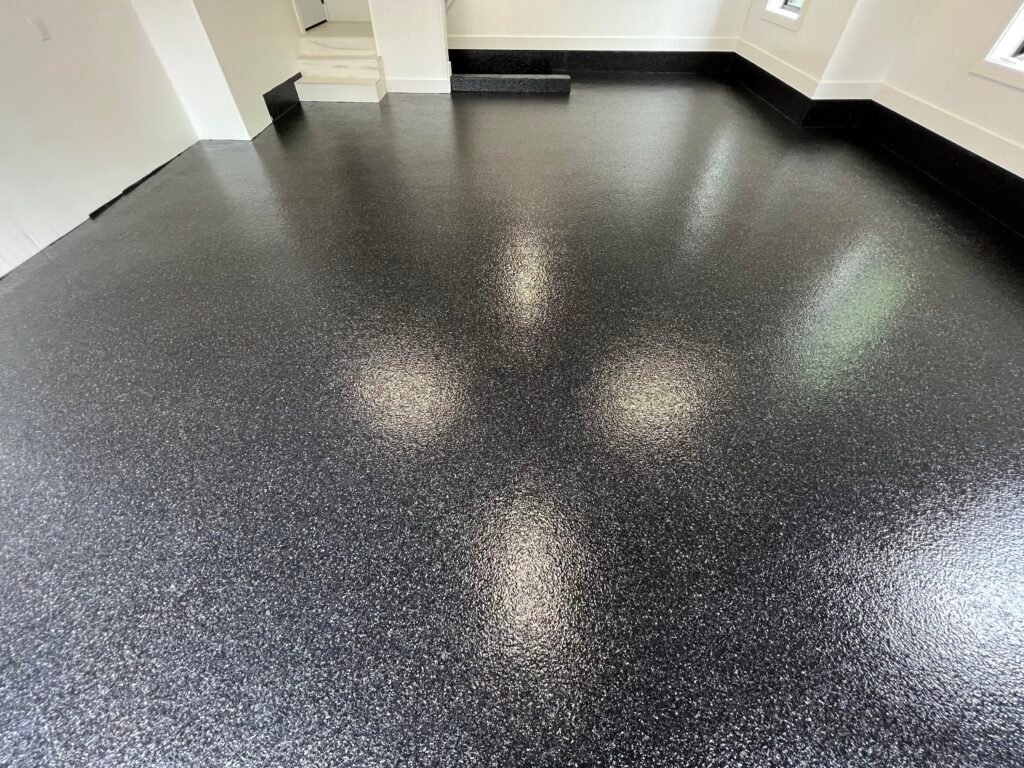
Choose a Tough Coating With Built-In Traction
The best paint for garage floor non slip use is usually a two-part epoxy or polycuramine system with a traction additive or broadcast aggregate. These coatings handle heavier foot traffic, vehicle tires, oil drips, and routine cleaning better than basic concrete paint.
For a quick match:
- High-traffic garages and workshops: Two-part epoxy with silica sand, aluminum oxide, or calcined bauxite for added grip.
- Fast DIY projects: One-part epoxy paint with a compatible non-slip additive. It is easier to apply but usually less durable.
- Multi-use spaces, patios, and barefoot traffic: A finer-texture coating or polymer grit creates traction without an overly rough feel.
The right choice is not just about the paint can. Concrete must be clean, dry, degreased, and mechanically profiled or etched before coating. A properly prepared floor helps prevent peeling, while a textured topcoat helps reduce slips when water, oil, or wet shoes enter the garage.
I am Roger Aguiar, an Austin-based digital marketing professional who helps property-focused businesses explain practical buying decisions, including how to choose the best paint for garage floor non slip performance. Next, we will compare the main coating types and where each one makes sense.
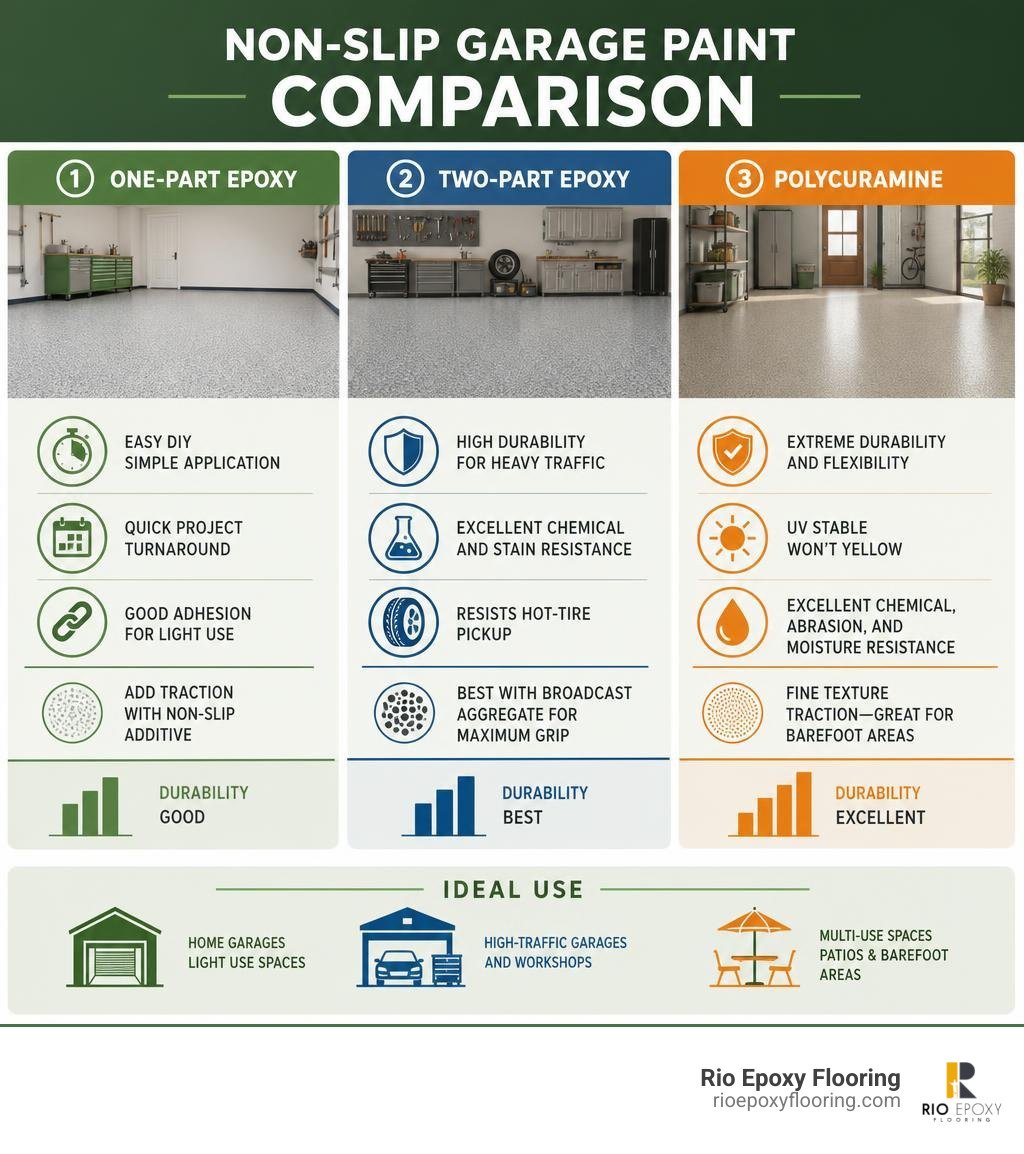
Comparing Formulations to Find the Best Paint for Garage Floor Non Slip Durability
Selecting the right coating starts with understanding how different products behave on a concrete slab. Standard latex porch paints sit on top of concrete like a film, while heavy-duty resin coatings chemically bond to the open pores of the substrate. Understanding the garage floor paint vs epoxy differences is essential before investing time and money into floor prep.
When tires enter a garage after driving on hot asphalt, low-grade coatings soften and stick to the rubber. As the tires cool and contract, they pull the paint right off the floor—a failure known as hot-tire pickup. Chemical resistance against road salt, motor oil, and automotive fluids also separates standard decorative paints from industrial-grade floor systems.
| Feature / Formulation | 1-Part Epoxy Paint | 2-Part Epoxy Coating | Polycuramine Coating |
|---|---|---|---|
| System Type | Single-component acrylic/epoxy blend | Resin + Polyamide/Polyamine Hardener | Proprietary hybrid resin blend |
| Solids Content | 30% to 50% | 50% to 100% | High solids (up to 96%) |
| Chemical Resistance | Moderate (household cleaners) | High (motor oil, gasoline, salts) | Very High (solvents, heavy chemicals) |
| Hot-Tire Resistance | Low to Moderate | High | Exceptional |
| Expected Lifespan | 1 to 3 years | 5 to 10+ years | 8 to 15+ years |
| Vehicle Cure Time | 5 to 7 days | 3 to 7 days | 24 to 48 hours |
Single-Component vs Multi-Part Systems: Best Paint for Garage Floor Non Slip Performance
Single-component systems, often sold as 1-part epoxy paints or water-based acrylics, offer unmatched DIY simplicity. There is no mixing ratio to calculate, no sweat-in induction time, and zero risk of the product hardening inside the bucket before you finish rolling. Products such as Valspar® Durable 1-Part Epoxy Concrete Paint are accessible for basic weekend projects.
However, these single-pack products rely purely on water or solvent evaporation to dry. Because they lack a chemical hardener, their cross-link density is lower, leaving them vulnerable to scratching under heavy toolboxes, hot-tire peeling, and gouging from gravel embedded in shoe treads. They deliver adequate performance for light foot traffic and storage spaces, but they wear down rapidly under daily vehicle movement.
Two-Part Epoxy and Polycuramine Heavy-Duty Systems
When durability in high-traffic garages is non-negotiable, two-component chemistries lead the pack. A two-part epoxy garage floor coating cures via an exothermic chemical reaction between an epoxide resin and a polyamine hardener. This creates a dense, rigid structural network that mechanically locks into concrete pores, resisting automotive fluids, floor jacks, and thermal shock.
Polycuramine takes this performance a step further by combining the high hardness of epoxy with the rapid curing and flexibility of polyurethane and polyurea. While standard epoxy can become brittle over time, polycuramine maintains slight elasticity, handling concrete micro-movement and heavy impacts without chipping. For property owners evaluating garage floor paint vs epoxy, multi-part formulations provide the strength necessary to hold aggregate tightly in place under grinding vehicle wheels.
Traction Mechanics and Texture Profiles
A common question among property owners is, are epoxy floors slippery? High-gloss resin finishes can become slick when wet, especially when rain, melted snow, or motor oil sits on the surface. Incorporating a dedicated traction profile ensures the surface exceeds occupational and residential slip-resistance benchmarks (such as a 0.50+ dynamic coefficient of friction).

Traction is achieved through two methods: mixing an additive directly into the wet paint before rolling, or broadcasting aggregate onto a freshly applied base coat and locking it in with a protective topcoat.
Broadcast Aggregates and Additives in the Best Paint for Garage Floor Non Slip Solutions
The size, hardness, and material of your non-slip additive dictate both grip level and longevity:
- Silica Sand: A classic, budget-friendly aggregate. It provides sharp grip but can wear down under intense, continuous tire friction.
- Calcined Bauxite: High-grade industrial products like PB Floor Paint Slip-Resistant | Polycote use calcined bauxite aggregate broadcast at rates between 5 and 18 m² per kilogram. This mineral provides extreme hardness and weather resistance.
- Aluminum Oxide: The hardest synthetic mineral additive available. It offers exceptional durability for commercial workshop bays and vehicle service stalls without crushing under heavy machinery.
- Polypropylene / Polymeric Beads: Lightweight spherical or micronized beads that remain suspended evenly in the paint can rather than sinking to the bottom, ensuring uniform distribution during rolling.
For maximum longevity, we recommend the broadcast-and-backroll method. Broadcasting aggregate across wet resin ensures an even distribution across the floor. Once the base coat tacks up, applying a clear topcoat encapsulates the particles, preventing them from dislodging during sweeping or power washing.
Barefoot-Friendly Textures for Multi-Use Garages and Patios
If your garage doubles as a home gym, workshop, laundry room, or opens directly onto a patio or pool surround, standard silica sand or coarse aluminum oxide can feel too harsh on bare feet.
For these multi-use spaces, micronized polymer additives and synthetic soft-grip aggregates provide friction without sharp cutting edges. Single-component coatings like Dura Grip use fine synthetic textures to create a barefoot-friendly profile that provides slip resistance in wet environments without irritating skin or tearing pet paws. These finer textures are also easier to mop clean compared to aggressive industrial grit profiles.
Concrete Surface Preparation, Coverage, and Application Rules
Even the highest-rated coating will peel if the underlying concrete is unprepared. Coatings rely on mechanical adhesion, meaning the concrete must have open pores to accept the resin.

- Degreasing: Scrub all oil spots and fluid leaks using an industrial, non-residual degreaser.
- Profiling (Grinding vs. Etching): Acid etching with muriatic acid or sulfamic acid opens the concrete pores. For maximum bonding, mechanical diamond grinding is the professional standard. When finished, the slab should feel like 120-grit sandpaper.
- Moisture Testing: Tape a 2×2-foot sheet of clear plastic to the concrete for 24 hours. If condensation forms underneath, moisture vapor transmission is too high for standard DIY paint, requiring a dedicated moisture-mitigating primer.
- Cleaning: Vacuum all residual dust completely. Learning how to properly prepare garage floor for epoxy after winter ensures road salts and freeze-thaw contaminants do not ruin adhesion.
Coverage Rates and Coat Schedules
Paint and epoxy coverage varies significantly depending on the porosity of your concrete and the solid content of the product:
- 1-Part Acrylic/Epoxy Paint: Delivers roughly 350 to 500 sq. ft. per gallon on smooth concrete, dropping to 250 to 300 sq. ft. on rough or etched surfaces.
- High-Performance Non-Slip Coatings: Formulations like Dura Grip cover up to 300 sq. ft. per gallon (or 75 sq. ft. per quart), including dedicated textured roller covers to maintain uniform film thickness.
- Industrial Polyurethane Paints: Single-pack polyurethane coatings with 45–49% solids typically provide 30 m² of coverage per 5L container (or 7kg packaging).
Always apply non-slip systems in at least two coats. Apply the first coat slightly thinner to allow deep substrate penetration. After a 4 to 6-hour dry window at 77°F (25°C), apply the unthinned second coat containing or encapsulating your traction aggregate to establish the final wear layer.
Curing Times and Traffic Readiness
Patience during the curing phase prevents premature failure and tire marks:
- Dry to Touch: 1 to 2 hours for fast-dry 1-part paints; 4 to 8 hours for two-part epoxies.
- Light Foot Traffic: 24 hours under standard conditions (70°F to 77°F, 50% relative humidity).
- Full Equipment & Heavy Storage: 48 to 72 hours.
- Vehicle Traffic: 5 to 7 days for 1-part epoxy paints to achieve full chemical cross-linking; 24 to 48 hours for fast-cure polyurea/polycuramine systems.
Applying coatings below 50°F or above 90°F can disrupt the curing reaction, resulting in cloudy finishes or reduced bond strength.
Frequently Asked Questions About Non-Slip Garage Floor Paints
Can non-slip garage floor paint be applied over existing coatings?
Yes, but only if the underlying layer is structurally sound. If the existing paint is peeling, bubbling, or lifting, applying new paint over it will cause the new layer to fail when the old layer detaches.
To recoat an existing painted floor:
- Scrape and sand away all loose and flaking material down to bare concrete.
- Scuff-sand the remaining glossy paint with 80-grit to 120-grit sandpaper to create a mechanical profile.
- Clean the surface thoroughly to remove sanding dust.
- Perform a test patch by applying the coating to a 1-square-foot area, letting it cure for 5 days, and testing adhesion with an X-cut tape test.
- Use a bonding primer to bridge compatibility between dissimilar resin chemistries.
How do you clean textured garage floor paint without damaging the aggregate?
Textured floors hold onto dirt more readily than smooth surfaces, but routine maintenance is straightforward:
- Sweep with Soft-to-Medium Bristles: Use a medium-bristled push broom rather than a stiff wire brush, which can shear off exposed aggregate particles.
- Use pH-Neutral Cleaners: Wash the floor using pH-neutral detergents mixed with warm water. Avoid strong alcohol-based solvents, high-concentration citrus degreasers, or bleach, as these can soften acrylic and low-solids epoxy binders over time.
- Rinsing & Drying: Rinse with a garden hose or a pressure washer set below 1,500 PSI (keeping the nozzle at least 12 inches away). Use a foam squeegee to guide standing water toward the garage door.
What colors and decorative finishes are available with non-slip paint?
Modern non-slip floor paints offer plenty of aesthetic versatility:
- Neutral Solid Tones: Slate gray, battleship gray, silver, and tan remain the most popular choices for hiding tire marks, road dust, and light oil drips.
- Vinyl Color Flakes: Broadcasting multi-colored vinyl chips into wet base coats adds a granite or terrazzo appearance while naturally adding light surface texture.
- Satin and Semi-Gloss: These finishes provide a clean, modern aesthetic without the blinding glare of high-gloss clear coats, making traction additives blend seamlessly into the floor.
Conclusion
Choosing the right non-slip garage floor coating comes down to balancing durability, application complexity, and traffic demands. While DIY 1-part paints offer a quick cosmetic fix, high-traffic spaces require the cross-linking strength of two-part epoxy or polycuramine combined with durable broadcast aggregates like aluminum oxide or calcined bauxite.
For homeowners seeking maximum longevity without the hazards of DIY peeling and extensive concrete grinding, professional systems provide an enduring upgrade. At Rio Epoxy Flooring, our family-owned team installs custom epoxy, polyurea, and cement-urethane floor coatings across Austin, Texas. We deliver rapid 48-hour installations using low-VOC, UV-resistant materials backed by a lifetime warranty.
Explore our comprehensive best garage floor coatings blog to compare professional floor systems and discover the ideal non-slip solution for your space.