

Choose a Rustic Garage Floor Epoxy That Lasts
A rustic garage floor epoxy combines the warm look of earth brown, mocha, copper, or subtle stone-like movement with a seamless coating built to resist stains, tire wear, and daily traffic. For the best result, choose an earthy color palette, add metallic pigment or decorative flakes for depth, and finish with a clear topcoat that includes an anti-slip additive.
Unlike bare or stained concrete, epoxy creates a protective surface that is easier to clean and less likely to absorb oil, chemicals, and dirt. It can also bring a farmhouse, workshop, or barndominium feel to a garage without the upkeep concerns of real wood or porous concrete.
A durable rustic finish starts with proper concrete prep. The floor must be clean, dry, mechanically profiled or etched, and repaired before any primer or color coat goes down. That work matters as much as the color choice.
I am Roger Aguiar, an Austin-based digital marketing leader who helps service businesses explain high-value upgrades clearly, including rustic garage floor epoxy options for homeowners seeking durable, low-maintenance design. In this guide, I will help you compare looks, materials, installation choices, and long-term value before you commit.

What Is Rustic Garage Floor Epoxy and Why Choose It?
When most people think of a garage floor, they picture cold, gray, industrial concrete that easily absorbs oil spills and develops spiderweb cracks over time. A rustic epoxy system flips that script entirely. By blending heavy-duty polymer resins with rich, organic pigments, it delivers the weathered, welcoming character of natural stone, aged leather, or stained hardwood while sealing the slab behind an impenetrable barrier.
Unlike basic DIY paints that peel under hot tires within a season, professional epoxy garage floor coating systems cross-link directly with the concrete pores. This fusion creates an impermeable, non-porous shield against motor oil, road salt, automotive fluids, and moisture vapor rising from the ground below.
The aesthetic appeal lies in its intentional imperfections—gentle swirls, warm gradients, and multi-toned veining that evoke old-world craftsmanship without sacrificing modern industrial durability.
| Feature / Metric | Rustic Garage Floor Epoxy | Bare Concrete | Standard Floor Paint |
|---|---|---|---|
| Aesthetic Appeal | Rich, organic, multi-tonal depth (copper, mocha, earth) | Dull, dusty, prone to permanent dark stains | Flat, uniform, prone to chipping and fading |
| Stain Resistance | Impermeable to oil, gas, antifreeze, and grease | Highly porous; absorbs spills instantly | Low; chemicals soften and lift the film |
| Hot-Tire Resistance | Excellent; withstands up to 400°F tire contact | Immune (uncoated), but concrete spalls over time | Poor; lifts and delaminates under warm tires |
| Tensile / Adhesion | >500 PSI bond strength (fails inside concrete) | N/A (uncoated base) | Typically <150 PSI (surface adhesion only) |
| Maintenance | Simple dust mop and occasional pH-neutral wash | Frequent sweeping, stubborn pressure washing | Constant touch-ups and eventual scraping |
Comparing Rustic Epoxy to Standard Garage Floor Finishes
The biggest difference between a rustic epoxy system and traditional floor coatings comes down to film build, chemical formulation, and surface density.
Standard acrylic garage floor paints simply dry through evaporation, leaving behind a microscopic film that measures barely 1 to 2 mils thick. In contrast, high-performance systems like the 80 oz. Metallic Earth Brown Garage Floor Kit (2-Pack) utilize advanced polycuramine chemistry marketed as 20x stronger than standard epoxy paint, curing in as little as 24 hours. Similarly, advanced commercial systems like the Metallic Epoxy Garage Floor Coating Kit – KAIDA PAINT® offer high-solids formulations designed specifically to withstand harsh mechanical loads and aggressive thermal expansion.
When cars park on concrete after driving down sun-baked Texas highways in September 2026, standard finishes soften beneath hot rubber. As the tires cool, they shrink and pull the paint straight off the slab—a dreaded issue known as hot-tire pickup. A rustic epoxy system bonds deeper, dissipating heat and resisting direct temperatures up to 400°F (ASTM D2485), ensuring your floor stays pristine year after year.
Versatility Beyond Garages: Basements, Patios, and Barndominiums
While this durable finish is a natural fit for garage workshops and auto bays, its rich look has made it a favorite throughout the modern home.
In barndominiums, rustic epoxy bridges the gap between rural architecture and sleek interior design, pairing effortlessly with reclaimed timber beams, black steel accents, and open living floor plans. Homeowners are also embracing these finishes below ground level; modern epoxy basement floors provide an organic, cozy aesthetic while protecting living spaces from subterranean dampness and seasonal hydrostatic pressure. Whether applied across a covered patio, home gym, or artisan studio, rustic epoxy offers a unified, high-end look that stands up to heavy foot traffic, dropped tools, and pet claws.
Popular Rustic Colors, Textures, and Design Techniques
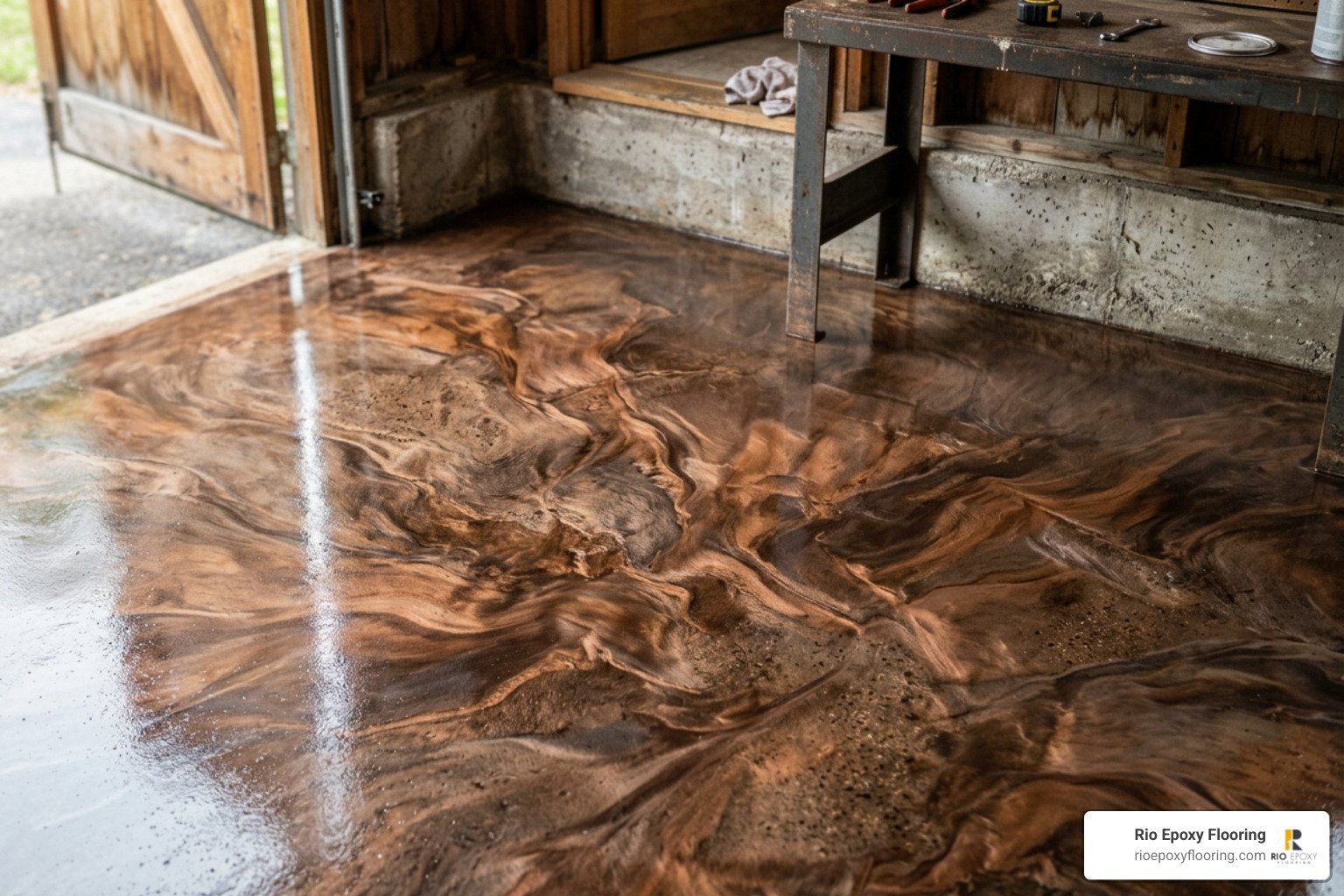
Creating a convincing rustic texture requires balancing earthy undertones with dynamic visual movement. Rather than a flat, solid color, rustic finishes rely on organic variations that catch natural daylight and warm artificial lighting from every angle.
Selecting the Perfect Rustic Garage Floor Epoxy Color Palette
The right color palette sets the tone for your entire space:
- Earth Brown & Dark Walnut: Creates a grounded, timeless base that mirrors natural soil and dark timber. Excellent for masking daily tracked-in dust.
- Rich Mocha & Espresso: Offers a warm, sophisticated look reminiscent of worn saddle leather or roasted coffee beans.
- Aged Copper & Bronze: Infuses metallic brilliance with reddish-brown undertones, mimicking oxidized iron and rustic metalwork.
- Warm Terracotta & Sandstone: Ideal for Southwestern, Mediterranean, or Spanish-revival home styles, delivering a sun-baked desert ambiance.
Metallic Pigments vs. Earthy Flake Blends
Homeowners generally achieve a rustic feel using one of two primary artistic methods:
- Metallic Pigments: Ultra-fine mica particles suspended in clear resin create a three-dimensional, marbled appearance with natural veining. By using specialized techniques featured in our metallic epoxy floor design guide, installers can manipulate the wet metallic powder using squeegees, rollers, or alcohol misting to simulate swirling river rock, polished granite, or molten bronze.
- Earth-Tone Flake Blends: Multi-colored vinyl color chips in shades of tan, brown, black, and cream are broadcast into the wet base coat. Flake systems provide a subtly textured, granite-like appearance that offers built-in slip resistance and conceals concrete surface flaws exceptionally well.

Step-by-Step Installation and Concrete Preparation Guide
Achieving a showroom-worthy floor that won’t peel, bubble, or lift requires meticulous planning. As outlined in our detailed epoxy flooring guide, roughly 80% of any coating’s ultimate success depends on how well the concrete is prepped before a single drop of resin is mixed.
Step-by-Step Application for Rustic Garage Floor Epoxy
- Mechanical Diamond Grinding: Acid etching alone is rarely enough for a lifetime bond. Use an industrial planetary diamond grinder to remove existing sealers, grease, and weak laitance. The concrete should feel like 80-grit sandpaper, matching an industry-standard Concrete Surface Profile (CSP-2).
- Crack and Spall Repair: Fill all expansion joints, micro-fissures, and divots with a high-strength polyurea or epoxy paste. Sand repairs flush with the slab to create a seamless canvas.
- Moisture Vapor Testing: Ensure concrete relative humidity and moisture vapor emission rates fall within manufacturer limits to prevent future bubbling.
- Wetting and Priming: Roll down a penetrating epoxy primer. This seals the concrete pores, halts outgassing bubbles, and creates a high-tack surface for the color coat.
- Base Coat and Rustic Effect Application: Pour the pigmented resin across the floor in ribbons. Spread evenly with a notched squeegee, then back-roll with a 9-inch or 18-inch lint-free roller. If applying a metallic finish, swirl the colors with a circular motion or lightly mist denatured alcohol across the wet surface to create natural mottling and organic veins. If using chips, broadcast them evenly to your desired density.
- High-Performance Clear Topcoat: Once the colored base cures, apply a protective urethane or polyaspartic clear coat. Incorporate an aluminum oxide or polymer anti-skid additive to keep the glossy finish safe to walk on when wet.
Common Installation Pitfalls and How to Avoid Them
- Outgassing Pinholes: Applying coatings while the garage warms up causes air pockets inside the concrete to expand and burst through the curing resin. Always apply coatings in the late afternoon or evening when temperatures are falling.
- Over-Working Metallic Resins: Fiddling with metallic pigments for too long after pouring will cause the mica flakes to flatten out, ruining the 3D optical depth. Respect the 1 to 2-hour working time window.
- Improper Mixing Ratios: Failing to blend two-component epoxies for a full 3 minutes with a mechanical drill paddle leads to sticky, uncured “soft spots” that will never harden.
- Trapped Surface Moisture: Never coat a floor that was recently pressure-washed without allowing at least 48 to 72 hours of dry time backed by a plastic sheet moisture test.

Durability, Heat Resistance, and Maintenance in 2026
Modern polymer engineering ensures your rustic garage floor is as tough as it is attractive. Industrial-grade formulations boast an adhesion strength exceeding 500 PSI (Elcometer 106 / ASTM D4541), meaning the concrete slab itself will tear apart before the epoxy delaminates from the surface.
Furthermore, high-solids clear urethane and polyaspartic topcoats achieve a pencil hardness rating of 4H (ASTM D3363) and an impressive abrasion resistance of only 18 mg loss after 1,000 cycles on the Taber Abraser (ASTM D4060). That means dropped wrenches, rolling floor jacks, toolboxes, and aggressive lawn equipment won’t ruin your floor’s artistic sheen.
To maintain clean indoor air quality during and after installation, choose low-VOC floor coatings that eliminate strong chemical odors while delivering industrial protection. Once cured, maintenance is simple: sweep away grit with a soft microfiber broom and mop monthly using warm water mixed with a cup of simple, pH-neutral floor cleaner. For homes subject to blistering summer conditions, check out our guide on how to maintain epoxy floors in heat to keep your topcoat glossy and protected.
Frequently Asked Questions About Rustic Garage Floors
Can rustic epoxy realistically mimic wood or natural stone?
Yes. Professional installers create authentic stone looks by layering complementary base colors—such as warm copper and espresso—and manipulating the wet metallic pigments with solvents, air blowers, or swirling squeegee strokes. To simulate weathered barnwood or flagstone, technicians can score shallow grout lines into the concrete and apply custom multi-tone wood stains underneath a protective satin or matte topcoat.
How long does a rustic epoxy garage floor last?
When properly prepared via diamond grinding and protected by a UV-stable urethane topcoat, a professionally installed rustic garage floor will last 15 to 20 years or longer. Unlike budget paints that chip within 12 months, industrial-grade epoxy will not yellow in sunlight, flake under hot tires, or degrade from road salt and battery acid spills.
How does the cost of rustic epoxy compare to standard floor options?
While professional rustic epoxy typically runs higher upfront than simple solid-color floor paints or plain concrete stain, it is substantially more economical than installing slate tile, porcelain flagstone, or hardwood planks in a garage setting. When you factor in its 20-year lifespan and virtually nonexistent maintenance costs, rustic epoxy delivers an outstanding return on investment while immediately boosting your home’s finished square footage and resale value.
Conclusion
A rustic garage floor delivers the best of both worlds: the timeless warmth of natural stone and aged leather combined with modern polymer durability. Whether you want to turn a crowded workshop into a stylish extension of your home or transform a garage into a rustic barndominium showroom, the right coating makes all the difference.
At Rio Epoxy Flooring, we specialize in custom, hand-crafted residential and commercial floor coatings that stand the test of time. Our family-owned Austin team uses premium, eco-friendly, low-VOC materials and rapid installation techniques backed by a lifetime warranty. Ready to upgrade your garage? Take a look at our guide to stunning epoxy floor colors and find the perfect rustic palette for your space today!