

Why Choosing an Austin Epoxy Floor UV Stable System Matters in Texas
Protecting your concrete surfaces from solar degradation requires an Austin epoxy floor UV stable system formulated with 100% solids resins, hindered amine light stabilizers (HALS), and non-yellowing protective topcoats. These specialized multi-layer coatings absorb harmful ultraviolet radiation, prevent chalking and amber discoloration, and withstand severe thermal expansion across high-exposure areas like garage aprons, patios, and pool decks.
Living in Central Texas means enjoying more than 225 sunny days every single year. While that endless sunshine is perfect for outdoor living, it creates harsh conditions for standard floor coatings. When concrete surfaces sit exposed to intense solar radiation and high summer temperatures, standard epoxy resins start breaking down at the molecular level.
Standard aromatic epoxies feature chemical bonds that react poorly to ultraviolet light. When exposed to relentless sunlight, those bonds break, leading to chalking, brittle surfaces, and an unsightly yellowish-amber discoloration. This issue is most visible right at the garage door threshold—the area known as the garage apron. Here, sunlight streams under open doors during the day, causing a distinct yellow strip right across the floor while the interior remains the original shade.
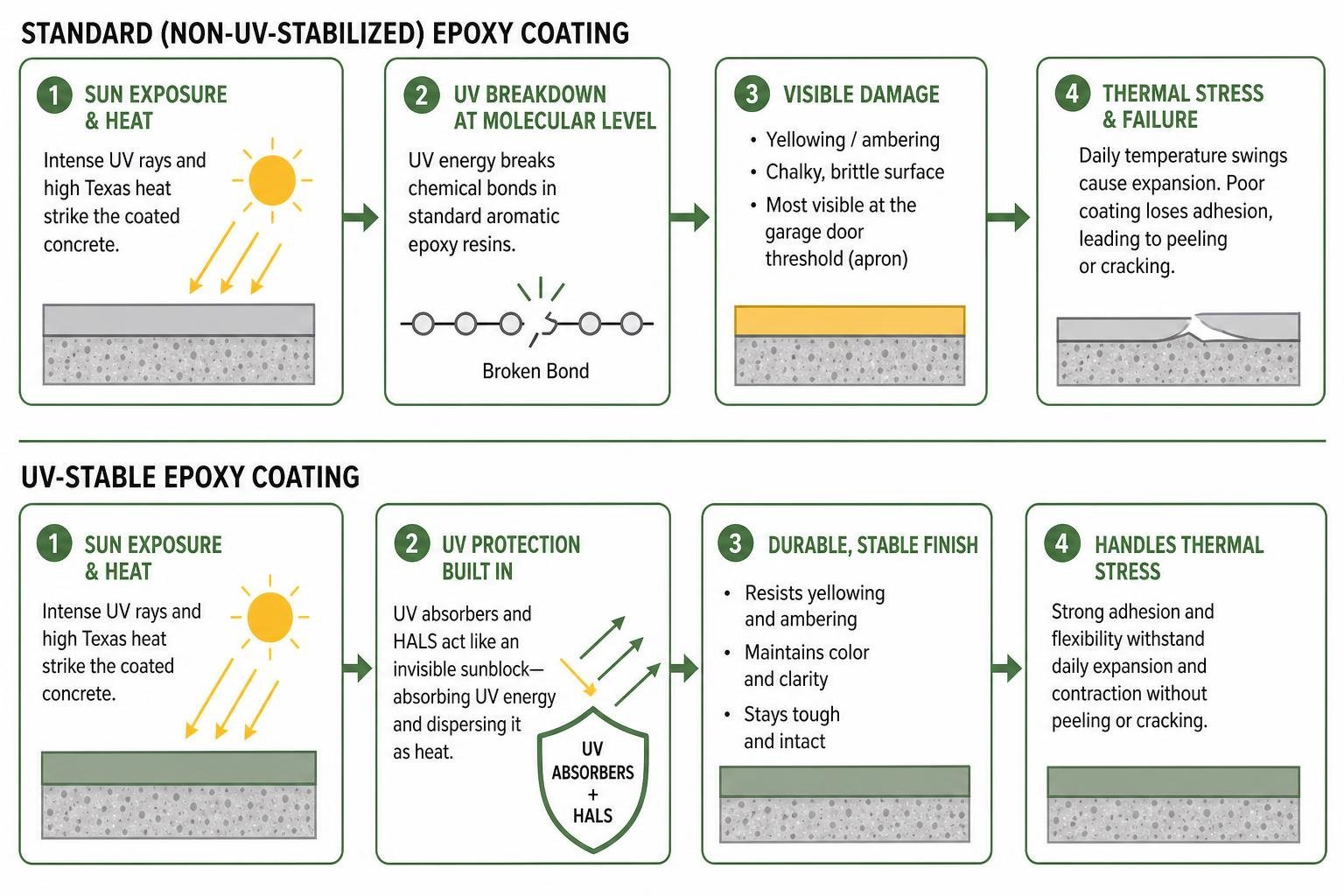
Beyond discoloration, excessive heat creates thermal expansion within the concrete slab. If a low-quality coating cannot handle these daily temperature swings, it loses its grip on the substrate. Homeowners often ask does epoxy flooring peel or crack in Texas summer heat, and the short answer is that non-UV-stabilized, low-solids coatings certainly will. Choosing an advanced formulation engineered for solar resistance protects your investment against both chemical degradation and thermal stress.
How an Austin Epoxy Floor UV Stable Formula Prevents Yellowing and Ambering
Modern UV-resistant formulations prevent ambering through specialized chemical engineering. Advanced clear coats, such as E671 UV Resistant Epoxy Floor Coating | 100% Solids , incorporate dedicated UV-absorbing additives and hindered amine light stabilizers (HALS). These compounds act like an invisible sunblock, absorbing harmful UV photons and dispersing the energy safely as heat before it damages the epoxy polymer chains.
This 100% solids formulation contains virtually zero solvents (VOCs under 2 g/L), meaning what goes down on the floor stays on the floor without shrinking or evaporating into the air. The result is crystal-clear optical clarity that highlights metallic designs and color chips beneath, giving you a deep, glassy look that will not turn the color of an old phone case after a single summer.
Critical Applications: Garages, Patios, and Commercial Breezeways
UV-stabilized floor systems are not only for fully outdoor spaces; they are essential wherever natural light meets concrete.
- Residential Garages: Our epoxy garage floor coating Austin TX installations routinely protect the sunlit transition areas near garage doors where vehicles and sunlight both beat down daily.
- Patios and Screened Porches: Covered outdoor living spaces benefit immensely from patio epoxy flooring Lakeway TX, which combines decorative style with weather protection.
- Poolside Spaces: Using a specialized pool deck epoxy coating creates a slip-resistant, UV-shielded boundary around pool decks.
- Commercial Entryways & Breezeways: Retail entry doors, auto shop bays, and restaurant walkways that sit open to the elements require continuous UV resistance coupled with heavy-duty foot traffic support.
Technical Performance, Primers, and Multi-Layer Topcoats
A truly durable floor coating is built as a complete multi-layer system. Even the finest UV-resistant epoxy performs best when paired with the proper moisture-mitigating primer underneath and a high-performance protective shield on top.
Before applying the build coat, proper priming is vital to prevent concrete outgassing—where escaping air creates pinholes in the liquid epoxy. Using high-solids primers like E5015 water-based epoxy primer or E707LVP low-viscosity primer ensures deep penetration into the concrete pores, forming an unbreakable bond.
| Performance Metric | Standard DIY Epoxy Paint | Industrial 100% Solids UV Epoxy | UV Epoxy + Polyaspartic/Urethane Topcoat |
|---|---|---|---|
| Solids Content | 40% – 50% (Water/Solvent Base) | 100% Solids | 100% Solids System |
| VOC Level | Moderate to High (>150 g/L) | Low (< 2 g/L) | Ultra-Low |
| Adhesion Strength | < 150 psi (Prone to peeling) | 350 psi (Concrete Failure) | > 350 psi (Concrete Failure) |
| Compressive Strength | 3,000 – 4,500 psi | 11,200 psi (ASTM D695) | > 11,500 psi |
| UV Discoloration | Yellows within 3–6 months | Highly resistant (Additive-stabilized) | Maximum UV resistance (No yellowing) |
| Abrasion Resistance | Poor (Scratches easily) | 36.0 mg loss (CS-17, 500 cycles) | Superior (< 20 mg loss) |
High-Performance Strength and Chemical Resistance
Industrial UV-resistant epoxy is designed to take severe daily abuse. Its high cross-linking density delivers exceptional mechanical properties:
- Adhesion Strength: Rated at 350 psi, which exceeds the tensile strength of the concrete itself (the concrete fails before the bond breaks).
- Compressive Strength: 11,200 psi (ASTM D695), easily supporting heavy pickup trucks, toolboxes, and hydraulic jacks.
- Tensile & Flexural Strength: 7,600 psi tensile (ASTM D638) and 7,400 psi flexural strength (ASTM D790), allowing the floor to flex slightly with substrate movement without fracturing.
- Surface Hardness: Shore D rating of 75–80, providing a rigid, impact-resistant surface that passes 50 in-lb direct impact tests.
- Abrasion Resistance: Under testing with a Taber abrasor (CS-17 wheel, 1,000-gram load, 500 cycles), it exhibits only a 36.0 mg loss, protecting your floor against dirt, grit, and tire wear.
- Chemical Protection: Resists splash and spills from motor oil, brake fluid, transmission fluid, gasoline, mild acids, and household cleaners.
Enhancing Protection with Polyaspartic and Aliphatic Urethane Topcoats
While UV-resistant epoxy build coats resist yellowing significantly better than standard resins, maximum outdoor longevity requires a non-yellowing clear topcoat. In high-exposure applications, we pair our epoxy core with an aliphatic urethane or high-gloss polyaspartic finish. When weighing epoxy vs polyurea garage floors Barton Creek property owners often choose a hybrid approach: an ultra-thick epoxy base for unbeatable adhesion, topped with polyaspartic for rapid curing and scratch defense.
Adding a topcoat like 322HW semi-gloss aliphatic urethane or E344QC quick-cure polyaspartic creates a dual barrier. The topcoat completely blocks UV-A and UV-B radiation while providing extreme scratch resistance, leaving the structural epoxy layer below fully intact and secure.
Design Versatility: Flakes, Quartz, and Metallic Pigments
UV stability is not just about clear resin—it also ensures your decorative colors remain vibrant for decades.
UV-Stable Color Flakes and Quartz Granules
For garage and patio floors, full-broadcast chip systems are a popular choice. We broadcast decorative vinyl flakes or colored quartz granules into the wet UV-resistant epoxy until rejection (complete saturation).
To ensure the floor retains its original look, we use outdoor-rated UV-stable chips and ceramic-coated quartz blends. These granules will not fade or bleach under sunlight. Once locked in with a UV-stable clear coat, the dense broadcast layer creates a rich, textured surface that naturally masks concrete imperfections while offering reliable slip resistance.
Artistic Metallic Pigments for Sunlit Interiors
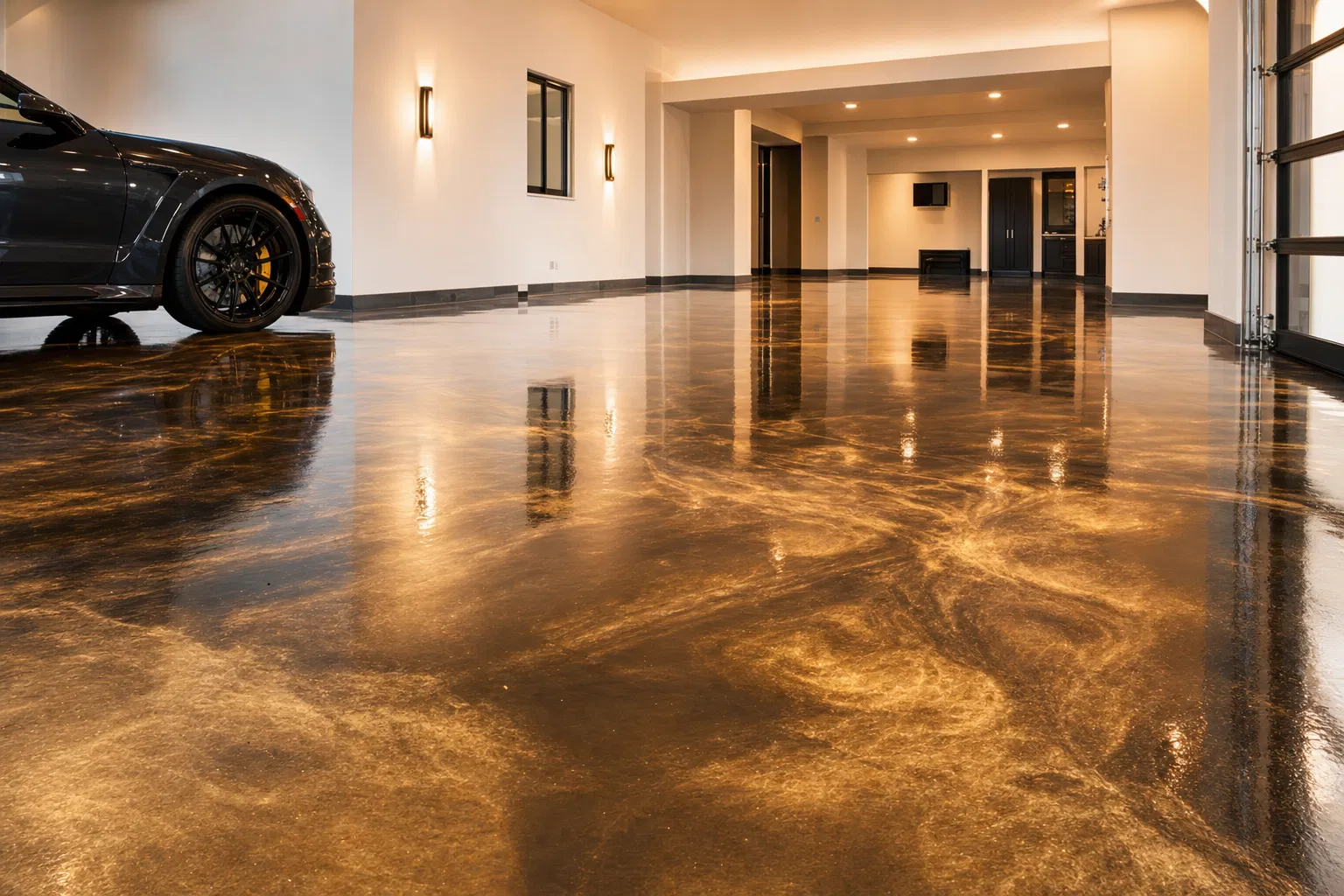
If you want a one-of-a-kind showroom floor, metallic pigments mixed into a crystal-clear UV-resistant epoxy base create stunning visual depth:
- 3D Marbleized Look: Natural flowing patterns imitate marble or granite slabs.
- River & Wave Effects: Skilled application techniques produce two-tone currents and pearlescent ripples.
- High-Gloss Light Reflectivity: The smooth, reflective surface brightens darker rooms by bouncing ambient light across the garage or showroom.
Because metallic designs rely entirely on the optical clarity of the clear epoxy matrix, using a UV-stable formula is mandatory. Without it, sun exposure through windows or garage bays will give the clear coat a cloudy, yellow tint, dulling the vibrant colors beneath.
Professional Installation, Cure Times, and Maintenance
Achieving a durable finish requires careful surface preparation and precise timing during installation.
- Surface Profiling: We mechanically grind or fine-brush blast the slab to achieve a concrete surface profile (CSP) of 2–3, opening the concrete pores and clearing away surface laitance.
- Moisture & Temperature Checks: We conduct moisture tests with plastic sheets or electronic meters and monitor surface temperatures. We apply materials only within the safe 55°F to 90°F range, keeping relative humidity below 85%.
- Mixing & Ribbon Pouring: We mix the two-component epoxy (typically a 2:1 ratio) using a slow-speed Jiffy mixer to avoid whipping air into the liquid. With a pot life of roughly 20 to 30 minutes for a 1.5-gallon mix, we quickly pour the material in ribbons across the slab to manage the reaction heat and spread it evenly with squeegees and rollers at 16–18 mils wet film thickness.
Regular care is simple: sweep up loose grit and mop with warm water and a neutral pH cleaner. For detailed summer maintenance tips, check out our how to maintain epoxy floors Texas heat care guide.
Cure Schedule and Project Planning Timeline
Planning around cure times ensures your floor cures completely without scuffs or indentations:
- Tack-Free Time: 7 to 10 hours at 70°F.
- Light Foot Traffic: Safe after 16 to 24 hours.
- Recoat Window: 12 to 24 hours (if exceeded, the surface must be lightly sanded to ensure mechanical adhesion).
- Full Cure & Heavy Vehicle Traffic: 2 to 7 days, depending on ambient temperature and humidity.
Coverage rates generally average 90 to 100 square feet per gallon at 16–18 mils thickness for smooth applications, adjusting slightly when broadcasting flake or quartz media.
Long-Term Cost Value of an Austin Epoxy Floor UV Stable Installation
While UV-resistant, 100% solids epoxy systems cost more upfront than hardware-store paint kits, they deliver much higher value over the life of the floor. Budget coatings often fail within 12 to 24 months in Texas, requiring costly chemical stripping, regrinding, and recoating.
Investing in a commercial-grade, UV-stabilized system protects the slab from cracking, spalling, and chemical degradation for decades. Whether you are upgrading an outdoor slab with an epoxy driveway coating or modernizing an interior space with premium epoxy flooring in Austin, the long-term durability and color retention make it a sound home improvement investment.
Frequently Asked Questions About UV-Resistant Epoxy Flooring
Can standard epoxy withstand direct sunlight in Austin without yellowing?
No. Standard aromatic epoxy resins naturally break down under direct UV radiation. Within a few months of sun exposure, standard clear or lightly pigmented epoxies turn an amber-yellow shade and will eventually chalk and become brittle. Sun-exposed areas require UV-stabilized epoxy formulations topped with an aliphatic urethane or polyaspartic protective clear coat.
What is the difference between 100% solids UV epoxy and standard DIY kits?
DIY floor paints sold in retail stores are typically water-based or solvent-based products containing only 40% to 50% solids. As they dry, over half the liquid evaporates, leaving behind a razor-thin coating (2–3 mils) that easily peels under hot car tires. A 100% solids UV epoxy does not evaporate during cure; it leaves a high-build, 16–18 mil thick shield that bonds permanently to concrete and resists tire pickup, scratches, and UV damage.
How do Austin temperature and humidity swings affect epoxy application?
High heat accelerates the curing reaction, significantly shortening the epoxy pot life once mixed. High humidity (above 85%) can trap moisture within the curing film, causing blushing or cloudiness. Professional installers monitor surface temperatures (maintaining the 55°F–90°F window), track dew points, and work during cooler morning hours to guarantee a smooth, complete cure.
Protect Your Investment with Rio Epoxy Flooring
Don’t let the Texas sun damage your garage floor or outdoor patio. At Rio Epoxy Flooring, we install custom, long-lasting epoxy, polyurea, and cement-urethane floor systems tailored for residential and commercial spaces across Central Texas. As a family-owned Austin business, we deliver quick 48-hour turnarounds, ultra-low VOC formulas, and durable installations backed by our lifetime warranty.
Ready to upgrade your concrete with a UV-stable system that stands up to the Texas heat? Contact Rio Epoxy Flooring today to schedule your consultation and get a custom quote.